Memory on Fabric – Textiles of Revolutionary China, 25-29 Sept

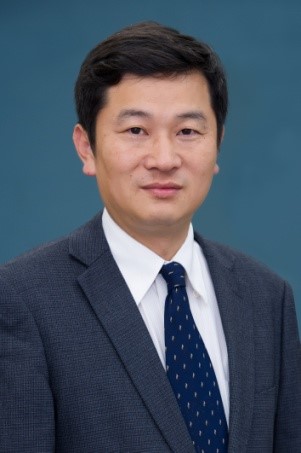
Following up on our spectacular exhibition “Poster Art of Modern China, 1913-1997” in 2014, we are proud to bring back Yang Peiming, Director of the Shanghai Propaganda Poster Art Centre to present his unique collections of Textiles of Revolutionary China to Edinburgh.

This exhibition presents a unique perspective and an intimate window into everyday Chinese life in the 1950’s and 1960’s, the collection of Chinese Bed Quilts uncovers more than a simple fondness for the auspicious colour red.

Lovingly preserved by the private collector Yang Peiming of the Shanghai Propaganda Poster Art Centre, this rare and unique collection will exhibit in Europe for the first time.

Offering viewers not only an opportunity to come face-to-face with the traditional beauty of an ancient culture, the exhibition also provides an insight to the complex history of a modern-day superpower.

Date and Time: 25 September – 29 September, 1000-1700
Location: Riddle’s Court, 322 Lawnmarket, Edinburgh, EH1 2PG

Real Music / Friday Lunchtime Tours – 20 Sept @ 12.30pm

Date and Time: 12.30, 20 September 2019
Location: Talbot Rice Gallery, Old College, South Bridge, Edinburgh EH8 9YL
Free Admission – no booking required

Professor Natascha Gentz is Chair of Chinese Studies and founding Director of the Confucius Institute for Scotland. Considering the ideas put forwards in Samson Young’s The world falls apart into facts, 2019, Natascha will discuss the negotiations between the so called West and East. From the Colonial relations at the time of Sir John Barrow’s Travels in China, 1806 (featured in the exhibition), to recent instances of mistranslation, this tour will explore some of the global social and political issues raised by Real Music.

Bringing in experts from across the University of Edinburgh and beyond, this lunchtime tours enable a deeper exploration of some of the complex issues raised through the exhibitions. Each week, following a short general introduction by one of the Gallery’s curators, a specialist from a different field will join us to expand upon the themes of specific artworks. Providing different perspectives on Samson Young’s Real Music the upcoming tours navigate through the history of experimental music, the transcultural negotiations of the colonial empire, future applications of the next generation sound synthesis research and the culture of tourist instruments.

Please visit Talbot Rice Gallery website: https://www.trg.ed.ac.uk/event/real-music-friday-lunchtime-tours-0 for further information.


Chinese films at Edinburgh International Film Festival 2019

The Confucius Institute for Scotland is delighted to be sponsoring Chinese film screenings at this year’s Edinburgh International Film Festival.

Up the Mountain

Part of the Documentaries Strand

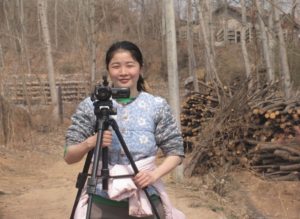
Up the MountainA portrait of a year in the painting studio of Shen Jianhua in Dali, Yunnan Province. Originally from Shanghai, Shen moved to the countryside to teach the local Bai women art and painting. The film documents both the fading traditions of the local community and the impact of a rapidly changing modern China. In the words of Wendy Ide from Screen International: ‘This lyrical documentary from Zhang Yang is a meditation on beauty.’ [U]

Up the Mountain is nominated for the 2019 Award for Best Documentary Feature Film.

Date and Time: 24 June, 20:20     Venue: Filmhouse

Date and Time: 26 June, 18:10     Venue: Odeon

For further details and book please visit EIFF website HERE.

Bodies at Rest

Part of the World Perspectives Strand

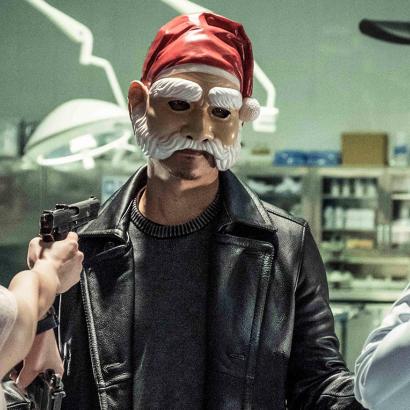
Bodies At RestHigh-concept action-adventure thrills ‘n’ spills from top genre director Renny Harlin, Bodies at Rest pays homage to the 1990s action skills Harlin refined in such films as Die Hard 2 and Cliffhanger. On a rainy Christmas Eve, the morgue of pathologist Nick Chan (Nick Cheung) and his intern (Yang Zi) is taken over by gunmen desperate to cover up a drug deal gone wrong. Taiwanese actor Richie Jen is great as the lead villain and the fight scenes make for great old-fashioned action mayhem. [15]


Date and Time: 20 June, 18:10  Venue: Odeon

Date and Time: 21 June, 20:40  Venue: Filmhouse

For further details and book please visit EIFF website HERE

From Shanghai with Love: 23 and 24 August 2019

After the sold-out success of 2017 and 2018, Donghua Edinburgh Centre for Creative Industries is set to return to the Edinburgh Fringe for the third time. Join us in the stunning Playfair Library on either Friday 23rd or Saturday 24th August for this combined exhibition and fashion show. Discover elegant, enduring and electrifying Qipao fashion, Shanghai Style, through the ages and into the future.

Our exhibition features Shanghai Style fashion from the Republican period and beyond. Our runway will feature contemporary and futuristic Qipao designs using the latest high tech materials and techniques, combining tradition with modernity.

Date and Time:

Friday 23 August 15.00, 18.00
Doors opened 30 minutes before the show to allow ticket holders to view the exhibition, enjoy a glass of fizz, and to choose seats. The exhibition remained open for 30 minutes after the show concluded.

Saturday 24 August 15.00, 18.00
Doors opened 30 minutes before the show to allow ticket holders to view the exhibition, enjoy a glass of fizz, and to choose seats. The exhibition remained open for 30 minutes after the show concluded.

If you missed the show last year, here is a short video that was taken on the opening day last year, enjoy!

Visit our microsite HERE for more details and Video Gallery for the previous show videos.

Bookings via the Fringe Box Office
Fringe Venue No 311:
Playfair Library, Old College Quad, South Bridge, Edinburgh, EH8 9YL

Chinese Brush Painting – one day workshop on Saturday 23 November

Bamboo has significant culture importance in China and other East Asian countries, represents good character of real gentleman and nobles. The traditional of bamboo and orchid painting had been around for many centuries and some techniques had been used for over 1000 years.

This one day workshop will start with introducing the history of Chinese bamboo painting then the common techniques related to the Chinese soft brushes and ink. Students can anticipate completing at least 3 pieces of Chinese painting artwork during the workshop. Demonstration and plenty of personal attention will be provided during the class. This workshop is suitable for both beginners and advanced students.

To secure your place on this enjoyable course please download this PDF Form which you will then need to complete and return to our office with a cheque made out to the University of Edinburgh for the appropriate amount. (Please note we are no longer accepting cash payment in our office)

The workshop will be led by our institute’s artist Chi Zhang. For more information and to see Chi’s work please visit HERE.

One-to-one tutorials and small group workshops can also be arranged.
Please email info@confuciusinstitute.ac.uk or call us on 0131 662 2180 to discuss.

Key Information

DATE: SATURDAY 23 NOVEMBER

TIME: 10AM-4PM

COST: £50 (£40) including all materials

LOCATION: Confucius Institute for Scotland Campus, Abden House


Chinese Calligraphy – one day workshop on Saturday 6 July

Chinese calligraphy is one of the earliest and most important visual art forms in China. As a practice, Chinese calligraphy is a calm, relaxing and meditative process, which benefits our well-being and leads to longevity. By controlling the special soft brush with a sharp point, Chinese brush painting is not only a mental exercise, but also a physical exercise that coordinates both mind and body.

No prior knowledge is necessary, you should simply be keen to learn and willing to hold a brush. All materials used during this workshop will be provided.
Join this session to try hands on and discover more.

The cost is £50 or £40 for university students’ concessions.

Combine this 1 day course with our Chinese brush painting workshop on Saturday 27 July for a discounted price of £80. Please visit here for details of brush painting workshop.

To secure your place on this enjoyable course please download this PDF Form which you will then need to complete and return to our office with a cheque made out to the University of Edinburgh for the appropriate amount. Cash payment can be made at the Institute in person.

This workshop will be led by our institute’s artist Chi Zhang. His Chinese calligraphy has been projected on Edinburgh Castle during the Edinburgh Military Tattoo in 2015. He also created calligraphy frontispiece for ‘Selected Poems by Robert Burns in Chinese Translation’, which was published by the Edinburgh University Press in 2010.

For more information and to see Chi’s work, please visit http://www.chizhangartist.com

One to one tutorials and small group workshops can also be arranged.

Please email info@confuciusinstitute.ac.uk or call us on 0131 662 2180 to discuss.

Key Information

DATE: SATURDAY 6 JULY

TIME: 10AM-4PM

Chinese Independent Documentary III

Wu Wenguang and the Folk Memory Project

Friday 31 May 2019, 2pm-7pm
Venue: 50 George Square, G.04 Screening Room

This event is free, but booking is essential. To book, please click HERE.

Folk memory project

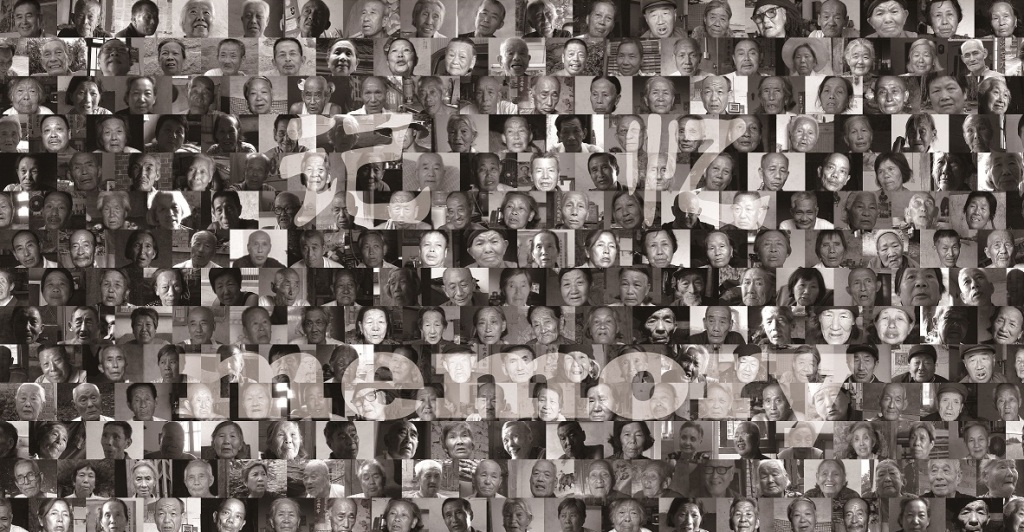
Knocking on Memory’s Door with the Video Camera. A handful of people took video cameras and went back to their respective villages. They went in search of the old generation that was still living there in dim, stark houses. They went to uncover the memories hidden deep inside them. Each filmmaker had some prior relationship to the village. Some of them were born or grew up there, some still live there, some had never lived in the village but had parents or grandparents who had. For the old people in the village, this was the first time anyone had come with a camera to ask them to open their memory chests. Here was the younger generation, leaping over their parents’ generation– that generation wiped clean of memory- to ask the elders about the past. This meeting may be awkward and uncomfortable but it is also an exciting adventure. Their stories are now documentary films presented in this program. [Wu Wenguang: The Art of Unforgetting: Folk Memory Project]

We are delighted to welcome China’s foremost independent documentary filmmaker back to the University of Edinburgh to present his most recent projects. Join us for an inspiring Friday afternoon of cutting edge documentary in China, insightful lectures, discussions and “meet the artist” conversations over drinks and nibbles. [Natascha Gentz, Director, Confucius Institute for Scotland]

Programme:

14.00 – 15.30 Film: Investigating my Father (Wu Wenguang)

 15.30 Tea & Coffee

16.00 – 17.00 Presentation: The  Art of Unforgetting: Folk Memory Project

(Wu Wenguang & Zhang Mengqi)

 17.00 Drinks & Canapés

17.30 – 19.00  Film: Self-portrait: Sphex in 47 KM (Zhang Mengqi)

19:00 Drinks reception

About the Presenters

Wu WenguangWu Wenguang is the internationally acknowledged doyen of Chinese independent documentary, producing acclaimed “unofficial” films in China since the late 1980s. In 2005 he created the Caochangdi Workstation as an independent space to focus on oral history and to document individual stories during particular difficult historical periods including the “Three year famine”, the “Great Leap Forward,” the “Land Reform” and the “Cultural Revolution”. This massive project is intended to create an independent folk memory archive, now involving 20 filmmakers, and more than 200 participants going back to their villages for interviews, with over 1500 interviewees from more than 300 villages.

Zhao MengqiZhang Mengqi was trained as a dancer and joined Caochangdi as a filmmaker and choreographer in 2009. Her films have been presented at international film festivals in China, Japan and Europe. The film presented in Edinburgh will complete her 8 “self-portrait series”.

About the Films

Investigating My Father

Directed, edited by Wu Wenguang

80 min. /2016

Filmmaker’s words:

My father was a landowner’s son and an ex-Kuomintang Air Force pilot, who remained in mainland China after 1949. For survival, he tried to transform himself from a man of the ‘old society’ to a man of the ‘new society’. As his son, I started investigating his ‘history before 1949’, which he had kept away from me. This film documents the process of my investigation over twenty years.

Self-Portrait: Window in 47 KM

Directed, photographed, edited by: Zhang Mengqi

Length:110mins

2019.3

Filmmaker’s words:

This is the 8th film in my documentary series “47 km.”

An 85-year-old man sits under Mao Zedong’s portrait and, as the sun sets, recalls his revolutionary history in pursuit of “New China.”

Meanwhile, a 15-year-old girl named Fanghong walks through the village with her paintbrush, knocking on the doors of elders’ dark rooms, sitting before them to draw their portraits. She’s like a ray of light illuminating their memories and ruins.

I followed Fanghong, and together we built a window for 47 km village.

The Red Heroine at Hippfest Bo’ness Saturday 23 March

For the fourth year our Institute is supporting Hippfest – Scotland’s only festival dedicated to silent cinema with world-class music, red carpet glamour, and rarely-seen silent era films. Taking place in the retro surroundings of the Hippodrome, Bo’ness.

Saturday 23 March 2019: 15.30

UK Premiere

The Red Heroine

The Red Heroine

£10 | £8 conc.

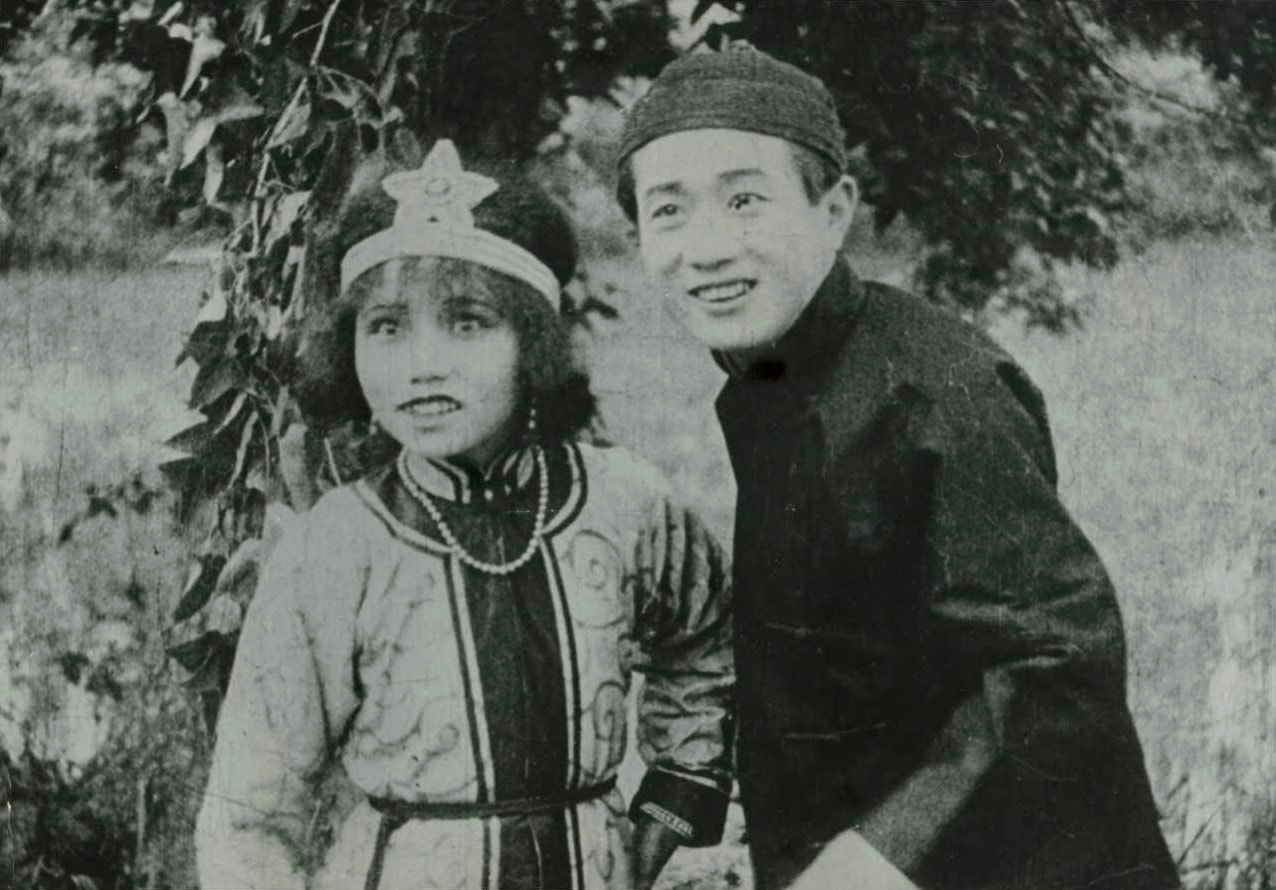
The oldest surviving Chinese martial arts film, featuring Fan Xuepeng – one of the first stars of the genre and an influential figure in the Chinese film industry who went on to establish her own production company. The ever-popular swordand-sorcery’s classic story structure of an innocent wronged by a villain, trained by a master, and returning to seek vengeance is all here. The occasionally clunky contemporary English translation of the intertitles, the fantastically pronounced teeth of the pantomime villain and the low-rent harem are all part of the fun, but the pay-off is a satisfying finale in which the Red Heroine shows everyone who’s boss.

Call 01324 506850 to book this event. Visit here for full details of the progamme.

HSK 2 Revision and Practice Starting 02 November 2021

Course Summary

HSK 2 Revision and Practice is to support those learners who are preparing for the HSK 2 test. Learners will have a total of 12.5 direct contact hours over the period of 5 weeks. This course is composed of three parts – mock tests, revision and practice. In this course, learners will have the opportunity to take simulated tests to help them understand the structure of the HSK 2 test. Revision is based on the mock tests where the teacher will identify the individual needs of students and suggest the necessary test skills. In addition to the mock tests and revision, 300 HSK 2 vocabulary and key grammatical structures will be reviewed and practised in this course.

Course Details

Date: 2 November – 30 November

Time: Tuesdays, 10am-12.30

Duration: 5 weeks, 5 sessions (2.5 hours each session)

Price: £102/£68 concession

To secure one of the limited spaces on this course, please use the University ePay system.

Teaching Methods

The class is structured in two stages. A student-centred learning and teaching method is applied in the first stage. A simulated test environment is created to encourage students to familiarise themselves with the real test on their exam day. After the mock test, the teacher will go through the paper. This will be a clinic study style in order to identify the areas students need to improve, and the teacher will provide the learners with the strategies of dealing with scenarios similar to the test.

The second stage applies a teacher-centred method. The teacher will go through the 300 HSK 2 vocabulary and focus on some common grammatical problems that arise among Mandarin language learners.

Essential Readings

Hanban. (2018) Official Examination Papers of HSK – Level 2 2018 Edition. Beijing: Higher Education Press.

Supplementary materials prepared by the teacher.

How strong is your vocabulary?

Try our Vocabulary On-line Self-practice to find out! Student will receive a full set of online practice in class. Before you start the class, why not try one of the below categories first?

HSK 2 Verb

Chinese bronze inscriptions and early Chinese culture and classics, Thu 18 April @6pm

Join us for the second lecture in our 2019 Distinguished Lecture Series when Professor Chen Zhi will give his lecture on Newly discovered bronze inscriptions of the late Shang and early Zhou dynasties and their significance for our understanding of early Chinese culture and classics

Chinese Bronze inscriptions first appeared in the Shang dynasty (17th-11th century B.C.); during the Zhou dynasty, the numbers of bronze ritual vessels with inscriptions increased exponentially. The Zhou bronze inscriptions extended to hundreds of characters. The contents mainly include eulogies of the Zhou ancestors and kings as well as historical records, which help us to fill significant gaps in our knowledge of Chinese history from late Shang through the Western Zhou dynasty (11th century-771 B.C.).

Focusing on recently discovered 11th century B.C. bronze vessels, Prof. Chen Zhi will lead the audience in reading the inscriptions to demonstrate the importance of these excavated texts as sources that require close reading. He will also re-interpret some of the texts of the transmitted Chinese Confucian classics, such as the Book of Odes, the Book of Documents, the Books of Etiquettes, based on the cross-references with these inscriptional documents.

One of these two bronze vessels, Ziyun Fuyi you (子㽙父乙卣), excavated from the tomb of Marquis of Haihun 海昏 (92-59 B.C.) of Western Han, apparently was a late Shang antique among the collection of the ill-fated monarch. The other Late Shang bronze Fu zun (婦尊) appeared on the antique market of Hong Kong in 2013. The content of the inscriptions on the Fu zun is about a royal wedding of a Shang King, possibly the notorious last ruler Zhou 紂 and one of his concubines.

Prof Chen will illustrate how the linguistic features of these inscriptional texts, such as the personal names of the Shang nobles, the terms of musical performance and instruments, and mentions of the sacrifices and etiquettes, etc can be analyzed to further our understanding of China’s ancient past.

Chen ZhiProfessor Chen Zhi holds a Bachelor’s degree in History from Peking University and a M. Phil in Chinese Literature from Nanjing University. He also has a PhD degree in Chinese studies from the University of Wisconsin at Madison, USA. Professor Chen started his teaching at National University of Singapore, Middlebury College and the UW-Madison. He joined HKBU in 2000, and served as Acting Dean of Arts, Chair Professor in Chinese Literature and the founding Director of the Jao Tsung-I Academy of Sinology. Currently he is concurrently appointed to the Vice President in Academic Affairs of BNU-HKBU United International College (UIC) at Zhuhai.

Professor Chen’s research interests lie in the areas of Chinese classics, bronze inscriptions, and ancient history of China. His publications include The Legacy of the Odes, Documents, Ritual Music (Chinese); The Shaping of the Book of Songs: From Ritualization to Secularization (English), Papers on Interdisciplinary Study of the Book of Odes (Chinese). He also has had dozens of papers in Chinese and English published in China, Taiwan, Europe and USA. Professor Chen is the editor of the Early China Book Series (Shanghai Classics), founding Chief Editor of the Bulletin of the Jao Tsung-I Academy of Sinology (Chung Hwa), the founding Editor of the Jao Tsung-I Library of Sinology (De Gruyter), and the founding Associate Editor of Journal of Early Chinese Philosophers (Shanghai Classics).

Date: Thursday, 18 April 2019

Time: 6pm – 7:30pm.

Location: Confucius Institute for Scotland, Abden House, 1 Marchhall Crescent, Edinburgh. EH16 5HP

A drinks reception follows after the lecture and Q&A.

All Welcome. Booking is required!

Registration deadline Thursday 21 February for offline HSK exam on 23 March

HSK is a globally run standardised test of Chinese language proficiency for non-native speakers. Whether to ensure eligibility for scholarships offered by Hanban, to gain an advantage in the job market or a related academic field an HSK pass will serve you.  And of course, for many adult learners, an exam is a great motivator for learning!

Our Institute can offer three opportunities to sit the HSK and HSKK (oral) exams in 2019. Dates for the exams are

  • Saturday 23 March 2019
    Register by 21 February for HSK and HSKK offline exam
    Register by 7 March for HSK online exam 

    Exam workshop: Saturday 9 March 2019
  • Saturday 11 May 2019
    Register by 11 April for HSK and HSKK offline exam
    Register by 25 April for online exam 

    Exam workshop: Saturday 27 April 2019
  • Saturday 30 November 2019
    Register by 31 October for HSK and HSKK offline exam.
    Register by 14 Nov for online exam
    Exam workshop: Saturday 16 November 2019

Please view our short video to learn more about this global exam and read on for detailed information on the various levels and FAQs.

If you are interested in working or studying in China or in applying for a Confucius Institute Scholarship in the future, then HSK, the Chinese Proficiency Certificate, is of interest to you.

HSK REGISTRATION

Applications for HSK exam will be available via the University of Edinburgh’s ePay website.  Please note this system does not offer a ‘shopping basket’ function. If you want to book more than one exam level or to book both HSK and the oral exam, HSKK,  you need to go through the booking process for each item you wish to book.

In addition to the online application and payment system please note you must also send two signed passport photographs (per exam) to the Confucius Institute for Scotland, Abden House, 1 Marchhall Crescent, Edinburgh, EH16 5HP.

An exam admission ticket will be posted to the address you provide on the form. You MUST bring this admission ticket and the identification document you used when registering with you.

March 2019 HSK and HSKK exam registrations are now open.

HSK Preparation

Prior to each exam diet the Institute will run a free workshop to introduce candidates to the exam format and strictures. It is highly recommended that all first time candidates attend this workshop.

A briefing will also be provided to those candidates taking the oral element of the HSK known as HSKK.

You can download sample papers online. Check out Hanban’s free online assessment website where these materials can also be found.

Online or Offline?

Candidates can sit the HSK in an on-line or off-line format. Generally we recommend that more advanced students, who are comfortable with using a keyboard to input pinyin and select the appropriate character, opt for the on-line exam. For less experienced students the off-line i.e. paper format exam is recommended.

The exam duration varies from 40 minutes at Level 1 to 135 minutes for Level 6.

FAQs

What is HSK? Levels 1-6: explanation of the different levels.
Why should I take an HSK exam?
What is the exam entry fee?
How do I find out which level of the test I should take?

What is HSK?

HSK (Hanyu shuiping kaoshi, i.e. Chinese proficiency certificate) is the official PRC standardised exam to assess Chinese language proficiency of non-native Chinese speakers. This category includes British, other nationalities, overseas Chinese and Chinese national minorities.

HSK is conducted at six levels running from 1-6. Please see the detailed information sheet outlining the examination standard for each level using the PDF links below.

HSK-level-1 2018
For students who have studied for 40-80 hours, have a vocabulary of approx 150 words and the corresponding grammar points

HSK-level-2 2018
For students who have studied for 80-120 hours, have a vocabulary of around 300 basic Chinese words and related grammar points.

HSK-level-3 2018
For students who have studied between 120-180 hours who have acquired around 600 basic Chinese words and related vocabulary points.

HSK-level-4 2018
For students who have studied Chinese for two academic years, 2-4 classes per week and achieved 1200 words and related grammar points.

HSK-level-5 2018
For students who have studied Chinese for more than 2 years (2-4 classes per week) who have a vocabulary of 2500 basic Chinese words and related grammar points.

HSK-level-6-2018
For students who have at least 5000 basic Chinese words and related grammar.

Why Should I Take an HSK Exam?

HSK is the only official Chinese language certificate accepted in mainland China. It is used by educational institutions and potential employers to:

  1. Certify that the holder has acquired the required Chinese proficiency to enter Chinese educational institutions as an undergraduate or postgraduate student
  2. Certify that the holder can be exempt from studying Chinese courses at certain levels
  3. Ensure suitable level of language skills as a reference point for employers recruiting non-native Chinese staff
  4. Eligibility for some scholarships requires HSK certification
  5. Adult learners are motivated to learn through assessment

What is the exam entry fee?

  • In 2019 the HSK Level 1 exam fee is only £10
  • In 2019 HSK Levels 2 and 3 have an entry fee of £30
  • In 2019 HSK Levels 4, 5, and 6 entry fee is £40

For those candidates who wish to test their speaking skills we also offer an Oral Examination component known as HSKK. This is offered at an additional cost of £15 and is optional but recommended.

Questions?

Should you have any questions please do get in touch:

Confucius Institute for Scotland in the University of Edinburgh,
Abden House,
1 Marchhall Crescent,
Edinburgh, EH16 5HP

Tel: +44 (0) 131 662 2180
Fax: +44 (0) 131 662 2199
Email: info@confuciusinstitute.ac.uk

Locating Fey Mou(s): The Topos of Chinese Film Theory by Victor Fan, 26 March, 6-8pm

Location: 50 George Square, Project Room (1.06), University of Edinburgh

A screening of Spring in a Small Town (dir. Fey Mou, 1948) is held on Monday, 25 Mar, 4-5:30 pm at David Hume Tower, LG. 06

Chinese film theory and criticism are often considered being radically different from their Euro-American counterparts. Yet, during the Republic period (1911–49), under colonialism and semicolonialism, Chinese filmmakers, critics, and intellectuals discussed the cinema with a vocabulary and an epistemic space that are already cross-cultural and inter-regional. In other words, ‘Chinese’ film theory has always been a comparative discursive space.

Yet, how do we reconstruct and rethink this comparative space so that we can make it useful for film and media studies today? In my seminar, I would like to use the theories of Fei Mu (Fey Mou, 1906–51) as a case study. Fey is best remembered for his 1946 classic Xiaocheng zhi chun (Spring in a Small Town, Wen Hwa Film Company). This film is about the unrequited love between a young doctor, Zhang Zhichen (Li Wei), and his former lover Zhou Yuwen (Wei Wei) now the wife of his best friend, Dai Liyan (Shi Yu). What could have been a melodrama was shot and edited in a highly lyrical style, with a series of long takes, elegant camera movements, and deep staging. Yet many people today forget that Fey was also a prolific writer of film criticism. In this presentation, I analyse Fey’s film theory in association with Spring in a Small Town, to examine how for him, cinema conveys a xingshi guan (view of forms), rensheng guan (view of life), and zhengzhi guan (view of politics). I shall do so by opening a comparative space between his theoretical writings and those of David Bordwell, Kristen Thompson, Christian Metz, and André Bazin on the relationship between art and reality. I argue that Fey’s ontological view is based in his belief in cinema’s ability to make present an absence, that is to allow life, its ontological order, and its regulating principles to manifest themselves without preaching them. Rather, they become palpable when the film image reveals the profound mundaneness of life, in which desire, longing, hope, and their attendant frustration and desolation obstinately hover around the cinematographic image as reality.

Victor Fan is Senior Lecturer in Film Studies at King’s College London. He is Film Consultant of Chinese Visual Festival (London). Prior to his position at King’s, he was Assistant Professor at the Department of East Asian Studies, McGill University. Fan graduated with a Ph.D. from the Film Studies Program and the Comparative Literature Department of Yale University, and an MFA in Film and Television Productions at School of Cinema-Television (now School of Cinematic Arts), University of Southern California. He is the author of Cinema Approaching Reality: Locating Chinese Film Theory, published in 2015 by the University of Minnesota Press. His articles have been published in peer-review journals including Asian Cinema, World Picture Journal, Camera Obscura, Journal of Chinese Cinemas, Screen, Film History: An International Journal, CLCWeb: Comparative Literature and Culture, anthologies A Companion to Rainer Werner Fassbinder and American and Chinese-Language Cinemas, film magazines 24 Images: Cinéma, Dianying yishu [Film Art], Zihua [Zifaa or Word blossoms], and Siyi.  His film The Well was an official selection of the São Paolo International Film Festival; it was also screened at the Anthology Film Archives, the Japan Society and the George Eastman House.

Besides his academic career, Fan is also a working composer. He was a performance artist with his own theatre company Post [ET]2! in Hong Kong between 1993 and 1996. He also worked as a freelance sound editor, film composer and re-recording mixer, and later on with Fissionarts (Los Angeles) and Solar Film/Video Productions (NYC) between the late 1990s and the mid 2000s. In New York, he also wrote for the magazines Film Festival Reporter and Film Festival Today, covering news from the MIX Festival, the New York Underground Film Festival, the African Diaspora Film Festival and MOXIE Film.

Chinese Language Classes Holiday This Week

Happy Spring Festival to all our students and friends!  Due to the Chinese New Year holiday (New Year’s Day is February 5), no evening classes will be held at the Confucius Institute for Scotland this week.  They will resume again as normal on February 11. 新年快乐!吉祥如意!We will be holding our annual party on February 8 from 6pm-9pm. Please sign up at:  https://edin.ac/2FSWKmT

Chinese New Year Events for All

chinese new year

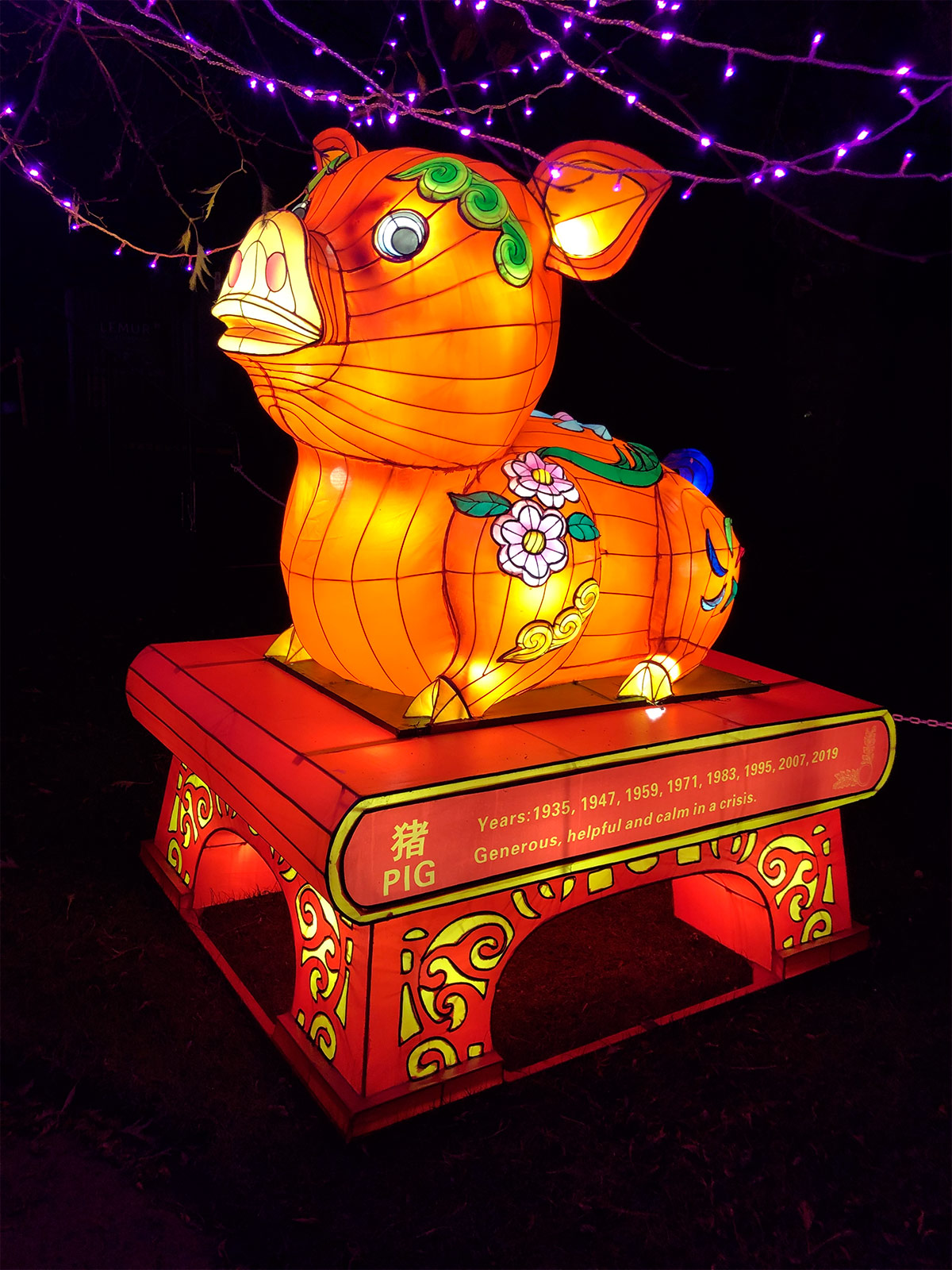
Join the Confucius Institute for Scotland team at some fabulous Chinese New Year events to celebrate the Year of the Pig which starts on February 5.   The Chinese New Year is also known as the Spring Festival.

January 24 6.30pm: China-Britain Business Council Chinese Burns Supper at the Waldorf Astoria. This was an evening blending the best of Chinese and Scottish culture in celebration of Robert Burns.  We sponsored an amazing line up of entertainment including the acclaimed Katie Targett-Adams who sings in Mandarin and English and plays the harp.  We flew Katie to Edinburgh specially for the event.  We

February 2 9am to 2pm: The Confucius Institute for Scotland stall at the Farmer’s Market, Castle Terrace, Edinburgh – special activities for kids and adults.  Our Chinese teachers and staff  entertained visitors with a range of fun and intriguing cultural activities.  Visitors discovered their animal year and some lucky people won great prizes.

February 5 6pm: Come to Edinburgh Zoo – find us at the Creative Cabin for a night to remember – lots of wonderful Chinese cultural activities set amongst the stunning Great Lanterns of China.  Bring your sense of fun and curiosity to enjoy our much sought-after cultural experience and take home your creations.   The Confucius Institute for Scotland is sponsoring the Great Lanterns of China featuring vibrant lanterns of Chinese and Scottish mythical creatures and animals protected by conservation.  This lantern festival has been running since November and will end on February 17 – book your tickets at: https://www.edinburghzoo.org.uk/lanterns

February 8 6pm: Join the Confucius Institute for Scotland’s annual Spring Festival party to mark the arrival of the Year of the Pig. Meet up with friends old and new over some delicious jiaozi and a glass or two, and take part in cultural activities including mah-jong, calligraphy, karaoke and Chinese chess.  Please register to ensure your entrance and to allow us the chance to provide enough Chinese dumplings! Book your ticket now at:  https://edin.ac/2FSWKmT

February 15 6pm-7.30pm: Confucius Institute for Scotland Chinese New Year Reception at Edinburgh Zoo. A celebration to mark the arrival of the Year of the Pig including welcome speeches by Consul General Pan Xinchun of the People’s Republic of China, Frank Ross, the Lord Provost of the City of Edinburgh, Peter Mathieson, Principal and Vice Chancellor of the University of Edinburgh and Natascha Gentz, Director of our Institute and Assistant Principal (China), the University of Edinburgh.  Enjoy the festivities and gorgeous lanterns on display.  Places at this event are limited and booking is essential.  Participants must present the booking details at the event.

See our links below: Our Chinese language teachers and staff share their personal insights into the delights and mysteries of Chinese New Year, including food, feasts (and a crash course in cooking Chinese dumplings), traditions and myths and how to send greetings of luck.  Many of our teachers will be spending their first Spring Festival outside China so their stories come with extra warmth.

Confucius Institute for Scotland – Edinburgh Zoo’s Giant Lanterns of China Festival

Preparation of the Chinese New Year

Taboos During Chinese New Year

Chinese New Year’s Family Reunion Dinner – A Delicious Feast

How to Make Chinese Dumplings – A Crash Course

The Legend of the Beast Nian – Origins of Chinese New Year

Spreading Luck at Chinese New Year

Fortune God, Kitchen God, Door God – Gods at Chinese New Year

Six Week Evening Chinese Calligraphy Class – Running style from 26 February 2019

Discover the ancient art of calligraphy using the traditional Chinese brush and ink combination that has been in use for thousands of years.

The six week course runs from Tuesday evening 26 February to 2 April, and will be led by Chi Zhang, the Institute’s experienced calligraphy teacher. Students will be introduced to the materials of ink, brush, stone and paper, and initially common techniques will be introduced.

Burns Supper Red Red Rose

This six week course will start by introducing common techniques related to the Chinese soft brushes and ink. The course will focus on Running Style (Semi-cursive). Students will start to learn the basic strokes of running style. Running style also called semi-cursive script; this is a more flowing style in which strokes are allowed to run into each other.

Students can anticipate completing at least one piece of Chinese calligraphy artwork per class. The contents of this work could be a selected Chinese poems or perhaps an ancient master’s quotation. Demonstration and plenty of personal attention will be provided during the class.

With a maximum of 12 students in the class plenty of personal attention is guaranteed as well as clear demonstrations and instructions to help students develop their skills.  Both beginners and advanced students are welcome in the class.

The cost is £120 for the 12 hour course which runs Tuesday evenings from 6pm – 8pm from 26 February 2019. There is a concession rate of £100, which is offered only to full time students.  The fee includes all materials. A minimum of five students are required to ensure the class goes ahead.

To book download this Winter 2019 Six Week Calligraphy Course Form then complete and return it to the Confucius Institute for Scotland with a cheque for the correct amount made out to the University of Edinburgh.

KEY INFORMATION

Course: Six week Chinese Calligraphy – Running and Cursive Style  (Evening)
Date + Time: Tuesdays Evenings – 26 February – 2 April, 6pm-8pm
Cost: £120 (£100) including all materials
Location: Confucius Institute for Scotland Campus, Abden House

You may also be interested in our Brush Painting Class – click here for details.

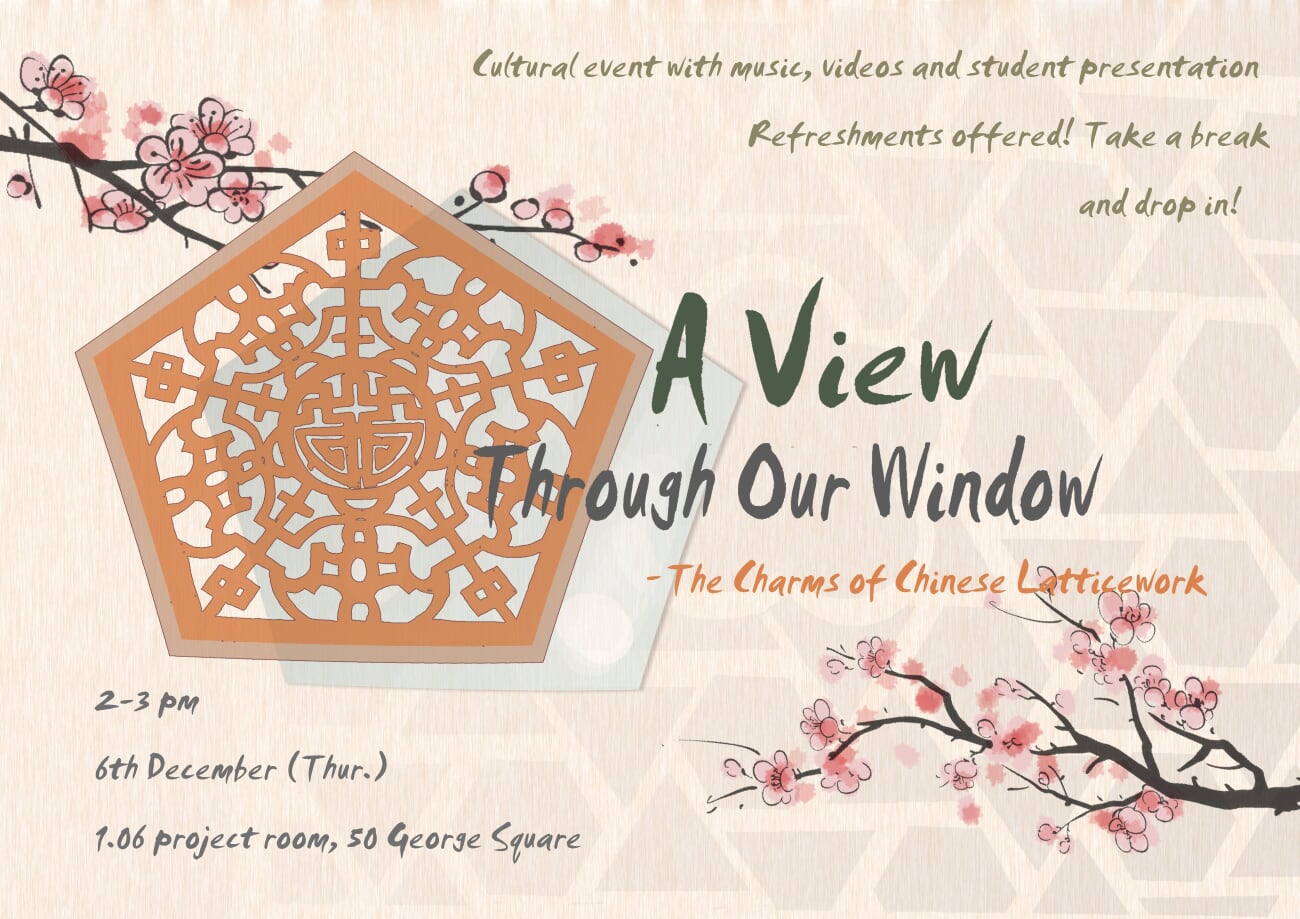
A View Through Our Window – The Charms of Chinese Latticework 6 December 2-3pm

Speak of windows, what kind of image pops into your mind? Transparent and bright? Or stained and classical? Has it ever occurred to you that there are wooden lattices covered by a sheet of paper and intriguing stories behind each and every window pattern? Have you ever thought of windows as works of art rather than tools of ventilation?

Dawn and Emily are visiting students at the University of Edinburgh and they are working on a project on Chinese latticework. They would love to share their stories and listen to yours! Join their event on 6 December at 2-3pm in Project Room, 50 George Square.

Grab a totally different idea of windows and lattices as well as a cup of tea and some light refreshments (including dim sum, vegan options provided).

Music and videos will also cheer you up during the cold winter day and stressful finals!

All Welcome! Booking is required. Reserve your place here: https://edin.ac/2FN24to

A View Through Our Window

THE CHINESE IN BRITAIN – A HISTORY OF VISITORS AND SETTLERS By Barclay Price

Today over 400,000 Chinese live in Britain, many more attend British universities, and an increasing number visit Britain on business and as tourists. But until now, there has been no comprehensive history of the Chinese who came to the country. This book tells that story, from the first recorded visitor in 1687 through to the twentieth century, drawing on accounts by visiting Chinese, newspaper articles, memoirs, royal diaries and other contemporary sources.

The book encompasses, among much else, the sailors who worked on British ships and briefly lodged in the country between voyages; the emergence of Chinatowns in London and Liverpool; servants; students; links to missionaries; Chinese entertainers; exhibitions relating to China; Chinese envoys and ambassadors; and British royalty’s engagement with visiting Chinese. The book also includes extended biographies of some of the most significant Chinese to settle in Britain, including the first such immigrant, who has been overlooked in the historical record.

The author also deals with the suspicion and prejudice that the Chinese have historically experienced due to their different physical appearance, dress and culture. At the same time, he shows the beneficial impacts Chinese visitors have had on British cultural life over three centuries. As China becomes a pre-eminent world power again in the twenty-first century, this book uncovers our long relationship with the country and its people.

If of interest the publisher’s link below offers pre-publication purchase at a discount. The book will be published in January 2019. https://www.amberley-books.com/the-chinese-in-britain.html

Barclay will speak to the The Scotland-China Association Edinburgh Branch on Tuesday 9th April 2019  at 7.30pm in the Meeting House.

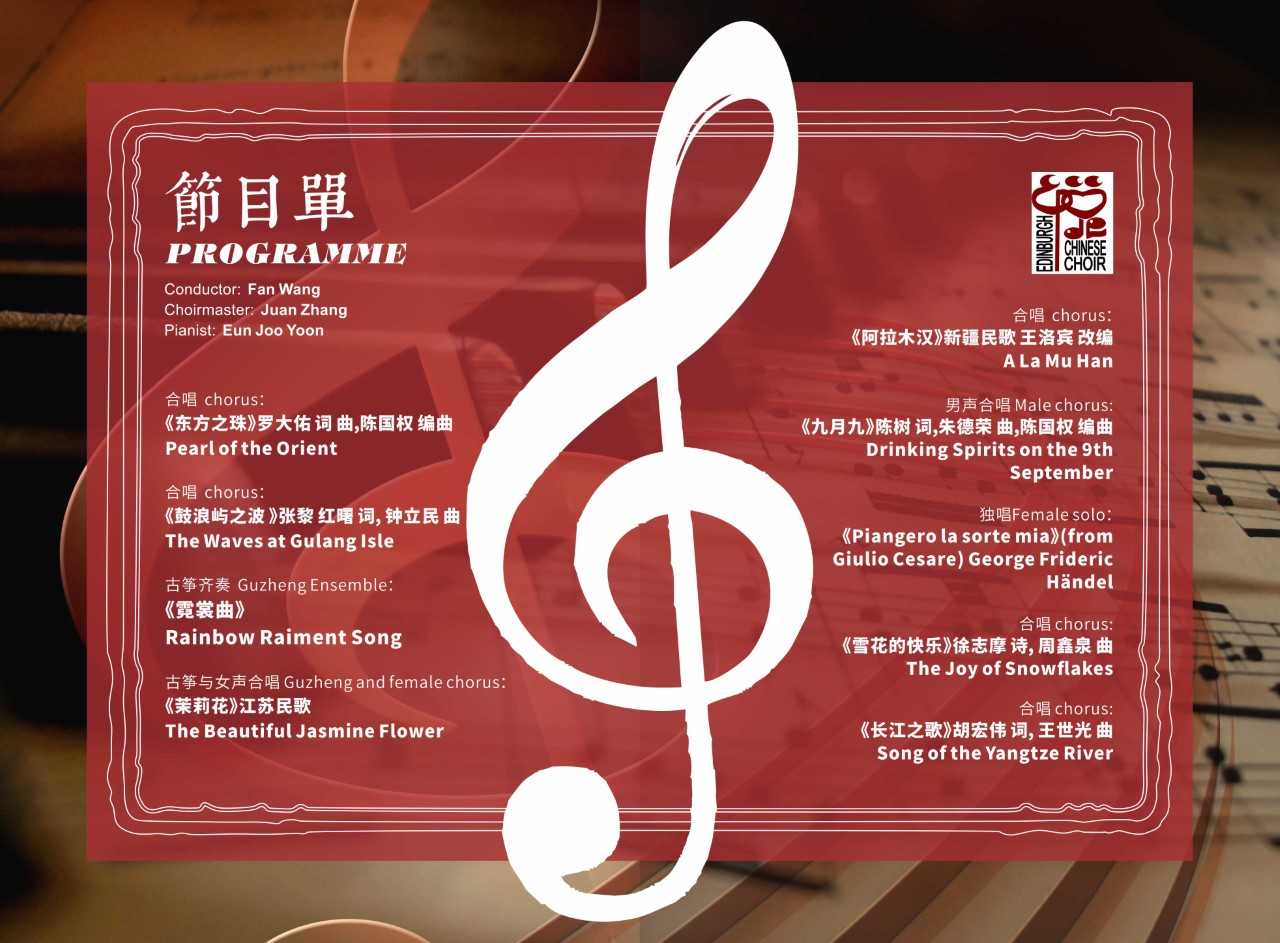
Edinburgh Chinese Choir Concert 2nd December 2018

Edinburgh Chinese Choir (ECC) was formed in 2011 by a group of music loving amateurs. By performing traditional and popular Chinese songs, they aim to add taste of Chinese cultural heritage to Edinburgh’s rich diversity of cultures, and to promote friendship and understanding through music. ECC has performed at Edinburgh Mela in 2012, 2013, and 2014. This year, their concert will take place on Sunday 2 December 2018.

Time: 4:00-5:30pm

Location: Polwarth Parish Church, 36-38 Polwarth Terrace, Edinburgh, EH11 1LU.

Free Entry. Donations welcome.

Website: http://www.ecc2013edinburgh.wixsite.com/ecchoir

Edinburgh Chinese Choir Concert