Edinburgh International Asia Conference 5 Feb 2016

Scotland’s first ever student-led Asia conference will take place on Friday February 5th 2016 at the University of Edinburgh’s Playfair Library. Registration is from 09.00 and the day will finish with a drinks reception from 17.30-18.30.

The conference theme “Will the 21st Century belong to Asia – Pioneer your future in Asia” will see up to 200 student delegates, contemplating a career in Asia, meet with professionals from a wide range of organisations. Students and businesses are invited to register via the EIAC website. Any business which wishes to send a representative can receive a sponsored place.  Please simply send us an email to info@confuciusinstitute.ac.uk giving us the name of the representative, their position and the company name and we will provide you with a booking code to use when registering on the site.

Keynote Speakers will be Fiona Hyslop, Cabinet Secretary and Lord Stephen Green, formerly Minister of State for Trade and Investment and Group Chairman of HSBC.  Guest speakers are the Principal of the University of Edinburgh, Sir Timothy O’Shea and Consul General of the PRC in Edinburgh, Mr Pan Xinchun.

In addition to the above there will be a number of workshops offered by businesses including:

Stewart Investors
Goldman Sachs
DLA Piper
Skyscanner
China-Britain Business Council
JET Programme
RioTinto
Scottish Government
Financial Times
LeapFrogInvestment
CRCC Asia
CGIF
Trust Fund of Asian Development Bank

The organisers and sponsors are keen to attract a wide range of businesses to attend the event to take advantage of the opportunity to engage and connect with Scotland’s most ambitious international students from across the globe.

The fundamental goal for the event is to launch an Asia-focused community aimed at fostering relationships between students and businesses.

For more information please download EIACprogramme-11,  visit the EIAC website.

This event has been sponsored by the University of Edinburgh, The Scottish Government and the Confucius Institute for Scotland.

Year of the Monkey Resources for Schools

An early Christmas present from British Council!

Discover what 2016’s Year of the Monkey symbolises using this new resource pack filled with fun activities based on Chinese culture and traditions. Start preparing for Chinese New Year, explore the mythology behind the Chinese zodiac and uncover what the Year of the Monkey actually means in 2016.

Take your students along on a journey with the Monkey King as he steals the pills of invisibility and then sets out to the west with his magical companions. Or, using the pack, teach them how to make traditional opera masks, draw monkeys using Chinese brush strokes, create decorative DIY kites and even learn some basic Chinese.

There are plenty of creative and fun ideas for you and your students to learn about the rich history and culture of China.  You can download the pack from British Council’s website using this link.

British Council would love to get some quick feedback from you on the Year of the Monkey pack and whether you will use it. Please complete this quick survey – it should take less than a minute.

Note: To listen to embedded sound clips, please download the education pack and open with Adobe Reader.

HSK Exam Dates 2016-registration now open

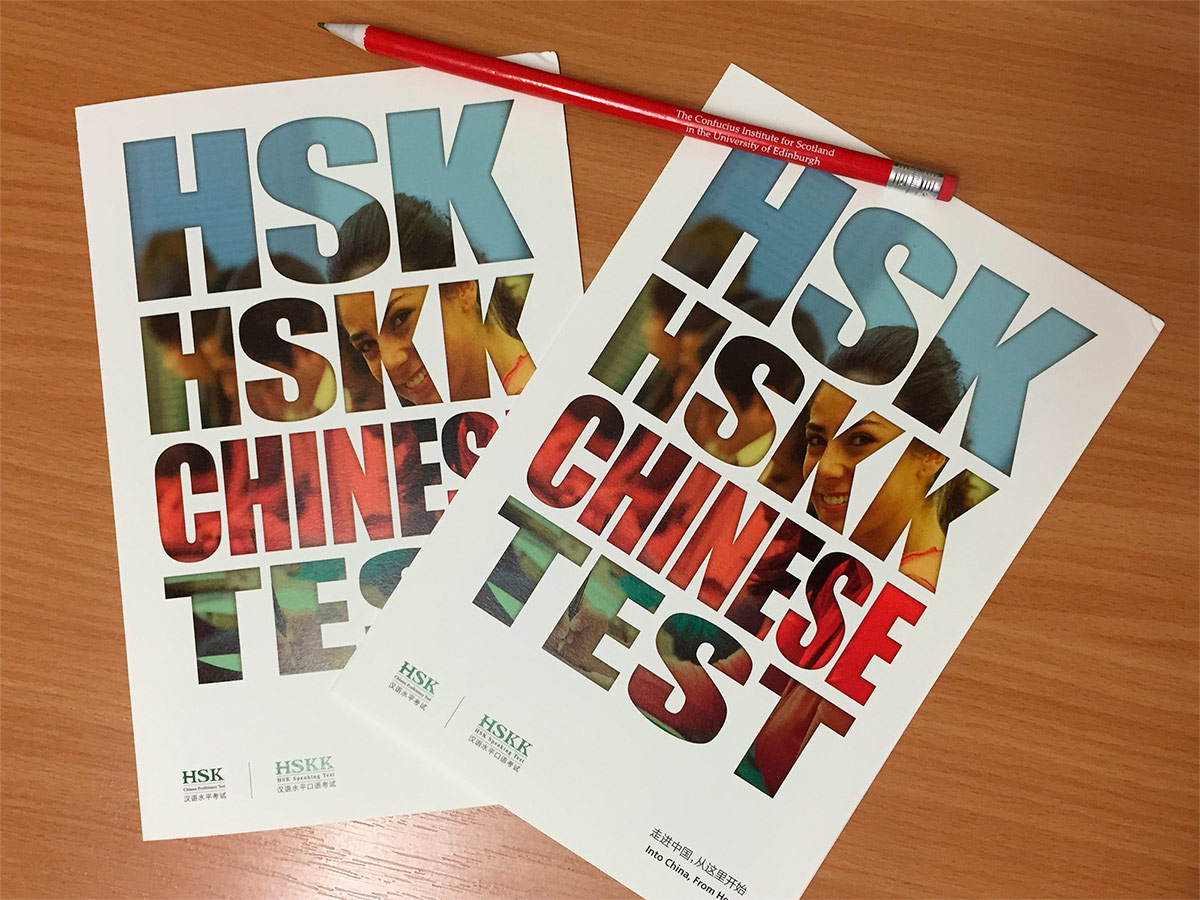
The Institute will run three HSK exam diets in 2016.  All exams take place on Saturdays with the dates being 19 March, 21 May and 3 December.  You can register now for the 19 March 2016 exam. If you are interested in working or studying in China or in applying for a Confucius Institute Scholarship in the future, then HSK, the Chinese Proficiency Certificate, is of interest to you.

We run exams from level 1 to level 6.  Students who have completed 40 hours of study should be able to secure a level 1 HSK certificate.

For full details of the HSK exam please visit the detailed information page here.

HSK


Office Closure Christmas and New Year 2019/20

Abden House

The Confucius Institute for Scotland in the University of Edinburgh will be closed from Wednesday 18 December and reopen on Monday 6 January 2020.  We send best wishes for the festive season to all our students and friends and we look forward to seeing you in 2020.

Classes will start again week beginning 27 January 2020


Model Institute Award Hanban Global Conference 2015

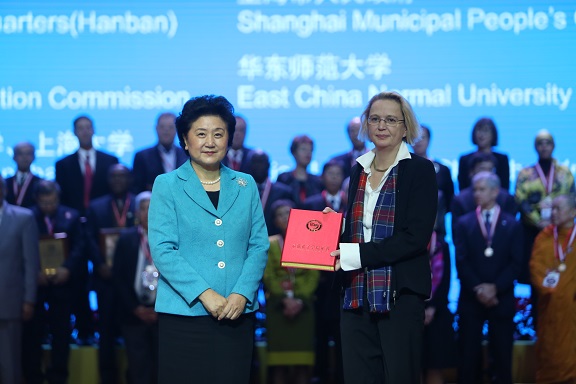
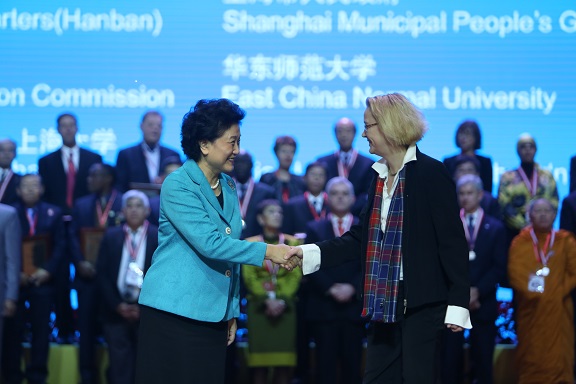
The 10th Global Conference of Confucius Institutes (CI) held in Shanghai in early December 2015 saw the Confucius Institute for Scotland receive the accolade of ‘Model Institute’ from Vice Premier Liu Yandong who is chair of the Council of CI Headquarters.  

Since opening in 2007 the Institute has received six awards of excellence from Hanban for the quality of its work and the impact of its outreach programmes. In 2008, the Institute coordinated the ten-month long ‘China Now in Scotland’ festival and significantly increased its programme of language classes. December 2008 saw a second Award for Excellence being given to the Institute. Additional Awards for Excellence followed in 2009 and 2010 culminating in a Gold Medal Award for Outstanding Contribution which was awarded in December 2011 with an additional award for Excellence being given also in 2012.

In 2014, the 10th anniversary year of the establishment of the network, the Principal of the University of Edinburgh received a  Pioneer Award – one of only 10 such awards marking the 10th anniversary of the establishment of the CI network. This year’s Model Institute award brings the total number of awards to the Confucius Institute for Scotland in the University of Edinburgh, to eight.

Also in receipt of an award for Confucius Classroom of the Year was the Confucius Classroom at the City of Edinburgh hosted by Leith Academy.

The global network stands now at 500 Institutes and just over 1000 classrooms in 134 countries around the world. For more information on the Conference please visit Hanban’s website here.

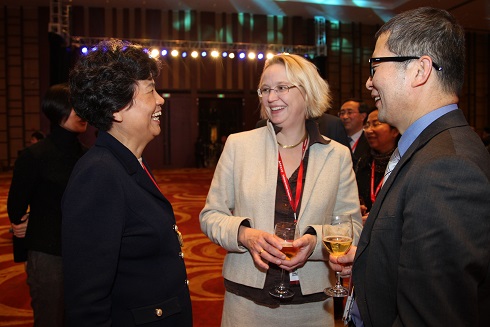
Photographs: Institute Director, Professor Natascha Gentz, is shown receiving and being congratulated on the award by Vice Premier Liu Yandong before chatting with Hanban CEO Mme Xu Lin along with Co-Director Dr Jin Ri. 

award

award

award

Golden Chopsticks Film Gala, 9 Dec 2pm-5pm

Students who take the course “Chinese Silent Cinema, 1922-1935” form groups and make their own 20-minute films modelled on the thematics and aesthetics of silent-era Chinese films.

As a conclusion to this class, all student films are shown at a mock Oscar event known as the “Golden Chopsticks Film Gala.” Judges made up of faculty members and experts determine Golden Chopsticks winners in ten categories: Best Picture, Best Director, Best Cinematography, Best Actress in a Lead Role, Best Actor in a Lead Role, Best Actor in a Supporting Role, Best Actress in a Supporting Role, Best Music, Best Set Design, and Best Poster.

Programme

2:00        Introduction
2:10       “Change of Heart” 覆水難收
2:50       “The Only Dance” 舞夜
3:30       “Blue Gardenia” 蘭梔子
4:00        Bloopers
4:30        Golden Chopsticks Awards
5:00        Farewell

Venue and Timing

The 2015 entrants for the ‘Golden Chopsticks’ award will be screened at 50 George Square Room G.04 Screening Room on Wed 9 Dec 2015 from 2pm-5pm.

Please click HERE to download the poster of the event.
For more information on this event and to view the 2014 films, please visit Chinese Silent Film page.

One Belt, One Road: Briefing Session, Report, & Webinar

On Wed 9 December in Glasgow, China Britain Business Council will run a briefing event focusing on opportunities for businesses related to the One Belt One Road initiative, launched by Chinese President Xi Jinping in 2013.

The programme will present the key findings of a report into this initiative to improve and create new trade routes, links and business opportunities with China, which will pass through over 60 countries along the way, through Asia, Europe, the Middle East and Africa.

Jeff Astle, CBBC’s Executive Director, and Nathan Blunt from the FCO, will lead the session along with panellists from companies which are actively involved. Initial opportunities exist in infrastructure development, financial and professional services, advanced manufacturing and transport, agriculture, energy and resources, logistics, construction and master planning, as well as regionally in ports, tourism and environmental industries.

If you are unable to attend the event but would like to either download the report or take part in a webinair session you can do so by clicking here.


Language Classes 2016 – now open for booking

We offer a diverse programme of evening classes for adults to enjoy learning Chinese. Terms run from Sept-Dec; Jan-Mar; Apr-Jun with a condensed programme of classes offered over the summer.

An absolute beginner can join us at the start of each term. Any student who has some previous experience in learning the language is welcome to drop in for an initial assessment to help determine which class would best suit.

Classes run for two hours on the same evening for a ten week term. After three terms most students are ready to move to the next level. No assessment is carried out but students are encouraged to test their developing skills by sitting the globally run HSK test.

Excellence in teaching is paramount. Most of our teachers are seconded from Fudan University which regularly send us experienced senior teachers and a number of Masters candidates in Teaching Chinese to Speakers of Other Languages. You can see the profiles of our current and previous teachers by clicking here.

LANGUAGE CLASSES January-March 2016

Course bookings for the winter term will open in December 2015. To get more information, register your interest in advance, or request an assessment meeting if you have some previous learning, please email: info@confuciusinstitute.ac.uk

CLass level Code Day(s) Dates-all 2016 Time Full Price / Student
Chinese 1.1  CH040-217 Monday 18 Jan-21 Mar 6.00-8.00pm £130/£86
 CH040-220 Tuesday 19 Jan-22 Mar 6.00-8.00pm £130/£86
CH040-219 Wednesday 20 Jan-23 Mar 6.00-8.00pm £130/£86
 CH040-218 Thursday 21 Jan-24 Mar 6.00-8.00pm £130/£86
Chinese 1.2  CH044-217 Monday 18 Jan-21 Mar 6.00-8.00pm £130/£86
 CH044-218 Wednesday 20 Jan-23 Mar 6.00-8.00pm £130/£86
Chinese 1.3 CH046-208 Thursday 21 Jan-24 Mar 6.00-8.00pm £130/£86
Chinese 2.1  CH041-207 Wednesday 20 Jan-23 Mar 6.00-8.00pm £130/£86
Chinese 2.2  CH037-206 Monday 18 Jan-21 Mar 6.00-8.00pm £130/£86
Chinese 2.3 CH011-205 Monday 18 Jan-21 Mar 6.00-8.00pm £130/£86
Chinese 3.1  CH045-205 Tuesday 19 Jan-22 Mar 6.00-8.00pm £130/£86
Chinese 3.2  CH036-206 Thursday 21 Jan-24 Mar 6.00-8.00pm £130/£86
Chinese 3.3  CH012-204 Thursday 21 Jan-24 Mar 6.00-8.00pm £130/£86
Chinese 4.1  CH038-205 Tuesday 19 Jan-22 Mar 6.00-8.00pm £130/£86
Chinese 4.2  CH013-205
Thursday 21 Jan-24 Mar 6.00-8.00pm £130/£86
Chinese 4.3 CH008-203 Tuesday 19 Jan-22 Mar 6.00-8.00pm £130/£86
Chinese 5.1  CH009-203 Wednesday 20 Jan-23 Mar 6.00-8.00pm £130/£86
Chinese 6.1  CH015-202 Wednesday 20 Jan-23 Mar 6.00-8.00pm £130/£86
Chinese 6.2  CH019-201
Monday 18 Jan-21 Mar 6.00-8.00pm £130/£86
Chinese Advanced  CH002-203 Monday 18 Jan-21 Mar 6.00-8.00pm £130/£86

Calligraphy Classes in the New Year

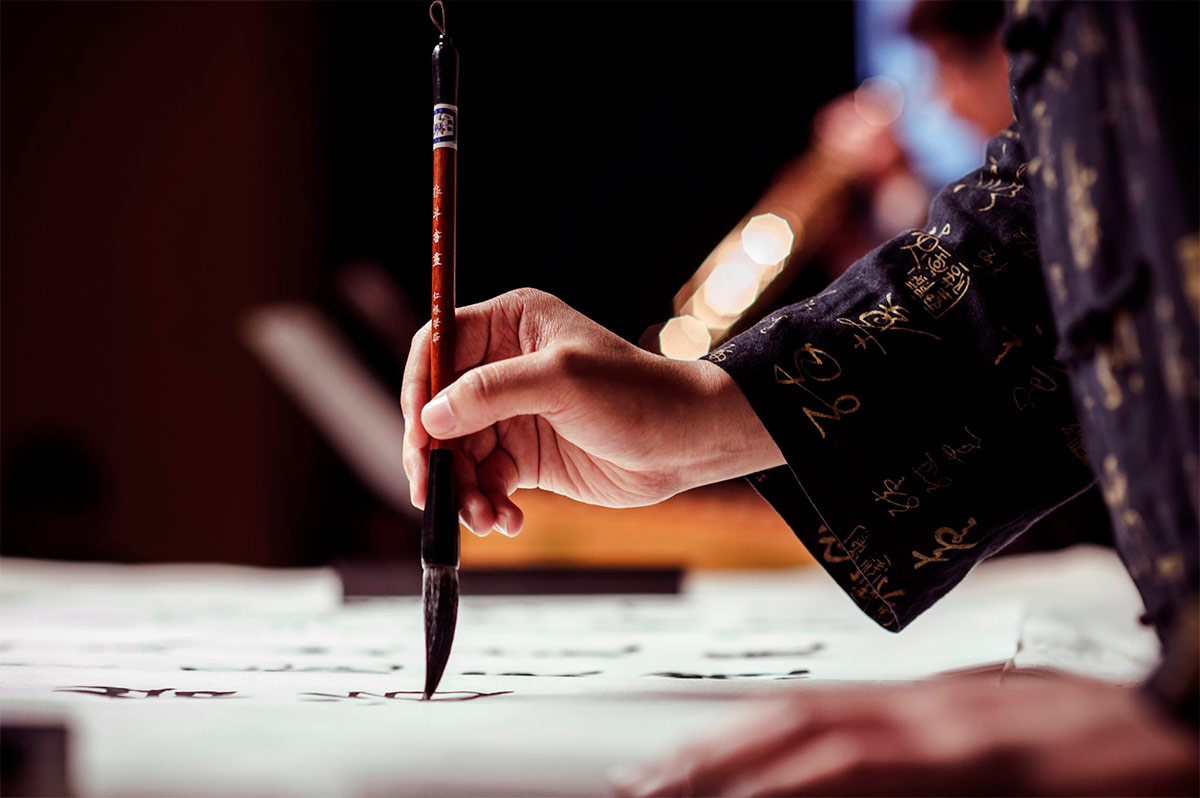
Our well established calligraphy classes run by Chi Zhang are open to both beginners and improvers.  Under the expert guidance of our calligraphy tutor many students have learnt the joy of discovering and practising this ancient art.

For next term, Winter 2016, we are running a 10 week course on Tuesday evenings 6pm-8pm with the first class starting on 19 January 2016.  Classes take place in the main teaching room of the Institute and all materials are provided.  Please note that this term there will be no class on Tues 2nd Feb 2016.  The final class will therefore take place on Tues 29 March 2016.

To book a place on this rewarding course please complete and return the registration form below along with your cheque payment for £150 (£120) made out to the University of Edinburgh. Cash payment can be made at the Institute office.

Winter2016-CalligRegForm.

Meantime, enjoy this video showing Chi Zhang at work and see some work made by his students.

Listen again or catch up2015 lecture podcasts

Here on this page you will find a number of podcasts and videos of previous events run by our Institute.

Lord Green: October 2015
China & Europe

Steven Green,  former chair of HSBC has a career spanning almost five decades. In this talk he compares and contrasts Europe and China from Confucius to Aristotle to the present day. For more information on this speaker and the talk please click here.


Shen Dingli October 2015
China’s Peaceful Rise: Challenges & Opportunities

Deputy Dean of  the Institute of International Studies at Fudan University and former advisor to Kofi Annan, Shen Dingli research and publications focus mainly on China-US security relations.For more information on this speaker and the talk please click here.


WAGnet Conference: September 2015
Memory, Gender & Change in China

A day long symposium on the above with contributions from a range of speakers on a variety of topics.  For more information on this event and the topics covered please click here.

KEYNOTE and PANEL 1

PANEL 2 and PANEL 3


Dr Andreas Guder, March 2015
Chinese as a Foreign Language in Germany

Dr Andreas Guder is based in Freie Universitat, Berlin where he is head of Chinese Language Study and Chairman of the Association of Chinese Teachers in German Speaking Countries. For more information on this speaker and his talk please click here.


David Shambaugh: March 2015
China at the Crossroads? Major Reform Challenges

David Shambaugh is Professor of Political Science & International Affairs and founding Director of the China Policy Program in the Elliott School of International Affairs at George Washington University. For more information on this speaker and his talk please click here.


Wang Ban: June 2015
Where Have All the villages Gone?

Wang Ban is the William Haas Professor in Chinese Studies and a board member of the Confucius Institute at Stanford University. His research focuses on Chinese and comparative literature, and additionally  he has written on English and French literatures, psychoanalysis, international politics, and cinema. For more information on this speaker and his talk please click here.


Zhang Longxi: April 2015
Reconceptualising China in our Time

A leading scholar in East-West cross-cultural studies Zhang Longxi holds an MA from Peking University and a Ph.D. from Harvard. He is currently Chair Professor of Comparative Literature and Translation at City University Hong Kong. For more information on this speaker and his talk please click here.


Lin Zhaohua: August 2013
Shakespeare in China

Following the staging of The Tragedy of Coriolanus at the Edinburgh International Festival by China`s best known director of modern drama, LIN Zhaohua, our Institute hosted an afternoon conversation session with him in partnership with the British Council and EIF in which he discussed this production and Chinese modern theatre.

Jim O Neill, June 2012
China and Its Place in the World

As chairman of Goldman Sachs Asset Management (GSAM) Jim was involved in helping guide all aspects of GSAM’s businesses around the world. One of the world’s most famous economists with over ten years experience at Goldman Sachs, Jim O Neill has a global reputation as a famous economist. Creator of the acronym BRICs, he has published extensively on the emergence of the BRIC economies -Brazil, Russia, India and China This video extract was recorded in June 2012 on the topic of ‘China and Its Place in the World’.

For more information on this speaker and his talk please click here.


Stephen Perry: May 2012
Everyone should understand China

Stephen Perry has been involved with China since his earliest days as his father was the leader of the Icebreaker group to China in 1953 which restarted UK-China trade relations just one year after starting up the business in which Stephen is today Managing Director, London Export Corporation.  He is also Chairman of the 48 Group Club. For more information on this speaker and his talk please click here.


Adam Dupre: April 2012
China/Scotland: the global context

Adam was the founder of China Company Research Services and the opening speaker in the Institute’s Business Lecture Series – China, Scotland and the World. An ex officio Vice President of the 48 Group Club he initiated earlier visits to Scotland by the Chinese Ambassador and the Chinese Minister of Education. For more information on this speaker and his talk please click here.

Calligraphy Competition-Scottish Heat Tues 1st Dec 2015 6pm

The Confucius Institute for Scotland is pleased to be hosting the Scotland heat of a global Chinese Calligraphy Contest being organised by Sinolingua. Taking place at the in the Institute at Abden House on Tuesday 1st December from 6pm, the competition is open to all non-native speakers of Chinese.

calligraphy

Many students enjoy learning Chinese characters. Some students take this enjoyment further by studying Chinese calligraphy while others start with an aesthetic enjoyment of the form. Whichever is the case for you, join us to take part in the heat. All participants will receive a beautiful calligraphy gift set and Chinese refreshments will be on offer during the evening. If successful you can progress to the next stage and might even be the winner of a return flight to China!

The theme of the competition is Chinese Calligraphy-an art of global appeal‘.

Programme for Tues 1st December

Confucius Institute for Scotland calligraphy teacher Chi Zhang will give a short lecture and demonstration before contestants take up their brushes. Contestants can choose which script to use and there is no limit on the content, number of words, signature etc. All materials will be provided.

All contestants attending on 1st Dec will receive a beautiful calligraphy gift set and Chinese refreshments will be available on the evening.

Competition Process

Representatives of SinoLingua (sponsors of the global competition) will take photos of each completed work while a video describing the creation of the work will also be made. Completed work will be uploaded to the Mass Selection website. There, following on from the judging, selected artwork will progress to the second round and hopefully to the Finals with the chance to win the top prize of a round-trip flight to China.

To arrange to take part or if you have any questions please email Chi Zhang.

This competition is organised by SinoLingua.  For more info please visit the competition website http://calligraphy.teachpal.com

China-A Science & Technology Superpower? 25 Nov 3.30pm

Join us when Prof Erik Baark from Hong Kong University of Science & Technology poses the question China – A Science & Technology Superpower?

With the rapid growth of Chinese investments in science and technology, and the expansion of outputs in terms of scientific articles, patents, and technological capabilities, some observers have predicted that China is on its way to becoming a technological superpower. This prediction is naturally based on the rapid developments in the input of R&D investment and output of scientific publications and patents that have taken place in China during the recent decades. But what does the concept of a scientific and technological superpower imply? In this talk, Erick Baark will discuss several interpretations of the concept of superpower and provide a preliminary assessment of key trends that have been seen as the promise of China’s emerging status. In his conclusion,he proposes that if, indeed, China is becoming an S&T superpower, one can hope that it will become a different type of superpower.

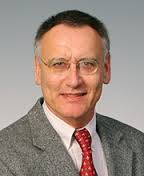
Erik BaarkErik Baark is Professor at the Division of Social Science and the Division of Environment at the Hong Kong University of Science & Technology. He completed a PhD at the University of Lund (1986) and a Dr.phil. at the University of Copenhagen (1998). His primary research interests are related to innovation systems and science and technology policy in China and other East Asian countries. His research on China includes analysis of information systems and IT development and high technology entrepreneurship during recent policy reforms. He has also published extensively on innovation in Hong Kong and the Pearl River Delta. He has published edited volumes and monographs, including Lightning Wires: Telegraphs and China’s Technological Modernization 1860-1890 (Greenwood Press, 1997). He has also published articles in leading international area studies journals such as The China Quarterly and innovation research journals such as Research Policy and the International Journal of Technology Management.

Lecture: China – A Science & Technology Superpower?
Speaker: Prof Erik Baark, Hong Kong University of Science & Technology
Date: Wednesday 25th November
Time: 3.30-5.00
Venue: Room LT2, University of Edinburgh Business School, 29 Buccleuch Place

For further information contact: X.Shen@ed.ac.uk

Jointly organized by the Institute for the Study of Science, Technology and Innovation and The Confucius Institute for Scotland in the University of Edinburgh. http://www.issti.ed.ac.uk/

Memory Gender & Change in China – WAGNet Podcasts

A day long symposium ‘Memory Gender and Change in China’ organised by WAGNet (Women and Gender in Chinese Studies Network) with the support of the Confucius Institute for Scotland took place on 11 September. Podcasts of the three panel sessions which addressed themes as shown below, are now available. Scroll down to access.

  • New wave feminism
  • LGBT communities
  • Campaigns against violence against women
  • Dating and violence
  • Reproductive cultures
  • Technologies of intimacy
  • Politics of photographic representation of the female body
  • Socialist masculinities
  • Men’s role in family planning and contraception
  • Transnational feminist organizing

Woman as manWAGNET CONFERENCE: Panel 1
Tradition and Change

Moderator: Prof Fiona Moore
Dr. Alison Hardie, University of Leeds
Dr. Wu Shengqing, Hong Kong University of Science & Technology
Dr. Xuelei Huang, University of Edinburgh
Dr. Francesca Bray, University of Edinburgh.

hold up half the skyWAGnet conference Panel 2:
Socialist heritage and contemporary resonances

Moderator: Prof. Francesca Bray, University of Edinburgh
Dr. Wang Xiangxian, Sociology, Tianjin Normal University
Prof. Fiona Moore, Royal Holloway, University of London
Dr. Wang Xiying, Beijing Normal University;
Dr. Derek Hird, University of Westminster.

anti domestic violenceWAgnet conference Panel 3:
From global to local: reflections 20 years after the UN Fourth World Conference on Women

Moderator: Dr. Xuelei Huang, University of Edinburgh
Feng Yuan, Media Monitor Network for Women and Shantou University
Dr. Robin Runge, George Washington University Law School
Dr. Wei Wei, East China Normal University
Dr. Sophia Woodman, University of Edinburgh (Local Organiser)

For more information on WAGNet please visit their website here.

Rising China and Global Impact13 Nov 3.15pm

Professor Tony Chan, President of Hong Kong University of Science and Technology, Asia’s No 1 University for three years in a row, will give a guest lecture on the topic of Rising China and Global Impact.

Globalisation, which calls for responses from many different sectors and stakeholders around the world, brings opportunities along with challenges. As such, rising China in the global arena is playing an increasingly important role in addressing the global imperative and shaping international agenda.  In the global marketplace, no champion can excel on its own.

How does one make sense of this ‘new’ internationalisation?  How does a university find its place in the midst of global cross currents? In the globalised context, which is always in flux, how do we go beyond traditional confines to soar as global players with global impact?

Biography

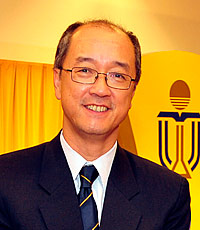
Tony ChanProfessor Tony F Chan assumed the presidency of HKUST in Sept 2009.  Prior to this appointment he was Assistant Director of the the Mathematical and Physical Sciences Directorate at the U.S. National Science Foundation (NSF), which is the largest directorate at NSF.

Professor Chan’s scientific background is in Mathematics, Computer Science and Engineering. He received his BS and MS degrees in Engineering from the California Institute of Technology (Caltech) and his PhD in Computer Science from Stanford University. He pursued postdoctoral research at Caltech as Research Fellow, and taught Computer Science at Yale University before joining the University of California at Los Angeles (UCLA) as Professor of Mathematics in 1986. He was appointed Chair of the Department of Mathematics in 1997 and served as Dean of Physical Sciences from 2001 to 2006. He also holds honorary joint appointments with the University’s BioEngineering Department and the Computer Science Department.

Event Details

Friday 13 November 2015
3.15.-4.00pm
Lecture Theatre 2, Appleton Tower, 11 Crichton St, Edinburgh, EH8 9LE

For more information on HKUST please click here.

Farmland for Farmers24 Nov 15 6.30pm

We are delighted to welcome Dong Zhenghua, formerly Distinguished Professor of Humanities at Peking University and now Professor of Chu Hai College for Higher Education, Hong Kong as the sixth speaker in our Distinguished Lecture Series 2015. His talk is entitled Farmland for Farmers: Problems of Large-scale Enclosure of Farmland in China.

Synopsis

One key question in today’s China is how to protect the farmers’ farmland? Under China’s ‘collective farmland ownership’ system, ultimate ownership of land is difficult to determine. With a growing economy, demand for land also grows.

Local government and real estate companies, can all too easily requisition land in the name of public demand with minimal compensation to the farmers. Conversely there is an increasing need for more agricultural activity.

At present there is a danger of large-scale enclosure of farmland becoming an acute issue and land related disputes being exacerbated. Is the solution to confer peasant families with perpetual rights under the Constitution? What would the impact of such a policy be and is there a way ahead which will treat individuals fairly and address the conflicting demands?

Biography

Dong ZhenghuaDong Zhenghua, former Director of the Centre for Modernization Studies (1999-2014) and Distinguished Professor of Humanities (2012-14) at Peking University, is currently a Professor  at Chu Hai College for Higher Education, Hong Kong.

His publications on agrarian problems include

  • Farmers onto Modernity (2014);
  • Nanjie Village: a Market Oriented Collective (Equity, Exclusion and Liberalization: a debate among historians-Papers of the 1996 SEPHIS workshop, Zanzibar);
  • Reserve the Land for Family Farming: On the Use of Farmland and the Future of the Peasantry in China (Global Capitalism and the Future of Agrarian Society, 2012);
  • Does China Need to Develop Agrarian Capitalism? (Chinese Studies in History, vol. 47, no.2, Winter 2013-14. M.E. Sharpe, Inc.)

Event Details

This talk will take place in the lower ground level lecture theatre LG.11 of the David Hume Tower, University of Edinburgh, EH8 9JY from 6.30pm.  A drinks reception will follow.  All welcome


Chinese Studies Seminar Series Semester One

This term the Chinese Studies seminar series features three visiting speakers on 21 October, 4 November and 18 November. All seminars will take place at 50 George Square from 15.00-17.00 in either G.05 or G.06.   The next lecture is on Wednesday 4 November.

Wednesday 4 November G.05 : 17.00-19.00

Dr Gerda Wielander (University of Westminster)
Happiness in recent Chinese socialist discourse – has Ah Q become a role model?

Happiness and prosperity have been core to Chinese socialist thinking from its inception. The Revolutionary Alliance Programme of 1905 used the term fuzhi to express its aspirations for a new society, a term most recently reintroduced by Xi Jinping in 2013. Socialism has never just been an aspiration to prosperity and redistribution of resources; it has always also held the promise of a new society, which would bring spiritual as well as materialistic transformation. In psychological terms, this anticipated transformation was built on the concept of “revolutionary spirit” (Larson 2009).

In this talk I argue that the emphasis on happiness we see in Chinese political discourse today ties in with the renewed emphasis on socialist values. It also highlights the ideological dilemma the party is facing as a ruling party which continues to espouse visions of ‘groundbreaking changes’ and future utopian societies while at the same time trying to elicit quiet contentment from all, including the most disaffected, by focusing their minds on seeing the glass half full. While adopting the proper spirit remains a key characteristic of subjective feelings of happiness, what exactly constitutes the proper spirit has changed from revolutionary optimism to something more akin to Ah Q’s “spiritual victory” method.

Gerda Wielander is Reader in Chinese Studies and Head of Modern Languages and Cultures at the University of Westminster, London. She obtained her Masters and PhD degrees from the University of Vienna with theses on Liang Qichao’s historiography (MA) and the contemporary Chinese language press in Malaysia (PhD). Her main research interest lies in the link between the personal and spiritual to wider social and political developments in modern and contemporary China. She is the author of Christian Values in Communist China (Routledge 2013) as well as several journal articles and book chapters. She is currently working on an interdisciplinary edited volume with the working title Perspectives on Chinese Happiness.

Wednesday 18 November G.06

Dr Phillipa Lovatt (University of Stirling)
Sound Music and Memory in JIa Zhangke’s ‘Hometown Trilogy

In Jia Zhangke’s ‘Hometown Trilogy’ the complex diegetic soundscapes, which are often recorded using the documentary method of ‘direct sound’, are represented as ‘occupied’ spaces: acoustic realms that are densely layered with the competing discourses of reform-era China. This paper explores how this experience of lived space during the period of China’s rapid transformation in the years following the end of the Cultural Revolution is articulated through sound and music. Through detailed analysis of particular scenes in Xiao Wu (1997), Platform (2000), Unknown Pleasures (2002) and his first student film Xiaoshan Going Home (1995), the paper will discuss how the layering of acoustic space within the films communicates the ways in which social and personal memories are connected by establishing both the atmosphere of an era within the diegetic space of the film through music, radio or television broadcasts for example, and by setting the (sometimes conflicting) emotional tone for each scene.

Wednesday 21 October G.05 – Now completed

Dr Charlotte Goodburn (Kings College, London)
Rural-urban Migration, Citizenship and China’s 2014 hukou reforms

In July 2014 the State Council announced ground-breaking hukou reforms, abolishing the urban/rural distinction that has existed since the 1950s. Much scholarship on citizenship in China, influenced by Dorothy Solinger’s important work, has focused on urban versus rural hukou as defining a binary system of unequal citizenship, privileging urbanites and denying genuine membership to rural people. Rural-urban migrants are in the worst position of all since, despite making up a third of China’s urban population, they are often unable to access urban state resources, including education, healthcare, housing schemes and social welfare.

Based on this picture, we might expect the 2014 hukou reform to have an equalising effect. However, this paper draws on the author’s research in Shenzhen and on other work on rural-urban migration to argue that, in fact, citizenship statuses are more complicated than Solinger’s model implies. In particular, the distinction between local and non-local, interpreted differently in cities of different sizes and now enshrined in the 2014 hukou reforms, creates a hierarchy of citizenship statuses with varying impacts on migrants of different ages, genders and areas of origin. Rather than moving towards universalization of Chinese citizenship rights, then, the current trajectory is actually one of increased citizenship differentiation.

The paper concludes by proposing an alternative theoretical model of Chinese citizenship, based on recent literature on international migration and citizenship. Drawing on concepts such as “probationary” citizenship, “localised” citizenship and “undocumented” migrants, it suggests a more nuanced way of thinking about citizenship and rural-urban migration in China.


Prof Shen Dingli, Fudan University: 29 Oct 15-6pm

As a distinguished scholar we are delighted to host Prof Shen Dingli, Deputy Dean of the Institute of International Studies at Fudan University to deliver a lecture on China’s Peaceful Rise: Challenges & Opportunities.

Synopsis

China’s rise certainly brings more opportunities to the world: increasing import of goods and services; and increasing export of tourist purchasing power, to name a few.  In terms of soft power, China is rapidly investing on its green energy sector and collaborating on climate change.  It is a major force of international combat against terror and pandemic diseases.  It is more visible on UN peacekeeping and disaster relief missions abroad.  Meantime, its rise does alter the world balance of power.  China’s rising strength of export and investment brings it more competence in manufacturing and international finance.  Its land and maritime Silk Road program offers the prospects of a better connected Eurasian continent.  Its ambition on the global commons has yet to reconcile with the concerns of the others.  This lecture will address the aforementioned issues, analysing China’s policy contour and its regional impact, especially on its relations with the neighbours and the United States.

BIOGRAPHY

Professor Shen DinliProfessor Shen Dingli is Deputy Dean of  the Institute of International Studies at Fudan University.  His research and publications focus on China-US security relations; regional security and international strategy; arms control and non-proliferation; foreign and defence policy of China, and the US. He received his PhD in physics from Fudan in 1989 and from 1989 to 1991 he engaged in arms control studies at Princeton University. In 1996 he was awarded Eisenhower Fellowship. In 2002 he was invited by Kofi Annan the then Secretary General of the United Nations to advise him on strategy planning for his second term.
Currently he also serves as Vice President at several academic associations, including the Chinese Association of South Asian Studies, Shanghai Association of International Studies, Shanghai Association of American Studies, Shanghai UN Research Association and Shanghai Public Policy Association.

Essential Information

Thursday 29th October 2015 6pm-7.30pm
Project Room 1.06
50 George Square
EH8 9JY

This lecture is part of the Confucius Institute for Scotland Distinguished Lecture Series in which experts and scholars on China and Chinese culture are invited to give a lecture on their chosen topic.

It is also part of the Discover Day programme organised by Fudan University, the Chinese university partner for the Confucius Institute for Scotland.

Fudan University Discovery Day:29 Oct 1pm-3.30pm

Partner of the Confucius Institute for Scotland, Fudan University is based in one of China’s most vibrant cities – Shanghai.

Find out more about Fudan University – and its network of Confucius Institutes – by dropping into the Project Room at 50 George Square on Thursday 29th October 1.00-3.30pm.  And join us for a special distinguished lecture from Fudan’s Prof Shen Dingli at 6pm.  Read on for more details.

FUDAN UNIVERSITY

Fudan University, based in the vibrant city of Shanghai is one of China’s leading Universities. Founded in 1905 Fudan University is composed of four campuses and has over 30,000 students.

In 2006 Fudan University was partnered with the University of Edinburgh as the Chinese partner in the about to be established Confucius Institute for Scotland. Since this time each year Fudan University sends teaching staff to the Institute to develop the Chinese language skills of the Institute and University students.

In addition Fudan also has partnerships with the Confucius Institutes in Auckland, Sydney, Hamburg, Frankfurt, and Nottingham Universities.

Exhibition

Drop in to the Project Room 1.06 in 50 George Square to chat through opportunities to study abroad for a semester or more. A number of University of Edinburgh students are currently studying at Fudan under joint programmes.   In addition each year there are a number of scholarship opportunities offered by various bodies to he University of Edinburgh and to the Confucius Institute network. Check these out by speaking to the exhibitors from Fudan University, Auckland University’s Confucius Institute, Hamburg University’s Confucius Institute, Nottingham University Confucius Institute and the Confucius Institute for Scotland here in the University of Edinburgh.

Entertainment

Take a seat and enjoy a cup of Chinese tea and a cookie while listening to the evocative sound of the Pipa and the Bamboo Flute. You will also have the chance to watch various forms of martial arts – and perhaps even try these out for yourself at an informal workshop.

Evening Lecture

Our Distinguished Lecture speaker from Fudan is Prof Shen Dingli, deputy dean of the Institute of International Studies. His talk entitled “China’s Peaceful Rice: Challenges & Opportunities” will consider how China’s rise is changing the balance of power in a number of fields – with its ambitions continuing to divide its critics. Join us at 6pm in the Project Room for this fascinating talk

All welcome!

Meet the team-new staff arrive

The autumn term regularly sees the Institute welcome new colleagues from our partner, Fudan University in Shanghai.  This year we are delighted to welcome six new staff each of whom will be with us till August 2016.  You can see the profiles of four of our new staff in the About Us section of the website.

Liu Xiang
Li Yuhan
Xie Jing
Chen Yihan

We warmly welcome our new colleagues.

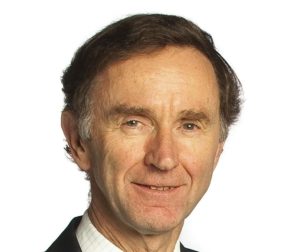
“China & Europe”Lord Stephen Green:15th Oct

Join us on Thursday 15th October when Lord Stephen Green, former chair of HSBC, will deliver a talk with the intriguing title “China and Europe, from Confucius and Aristotle till now: Old Histories, New Understandings”.

What do China and Europe have in common? And what sets them apart? In this fascinating talk Lord Stephen Green fleshes out the tensions and misunderstandings between these two strikingly different cultures, from Confucius to Aristotle to the present day. China’s economic might globally is deeply intertwined to its fascinating cultural fabric – and an enlightening lens to understanding where this global giant stands today. For Europe these are soul-searching times, as it enters the 21st century trying to re-define its common identity and getting its voice heard in a world of emerging great powers.

Lord Stephen Green

Stephen GreenLord Green has a career spanning nearly five decades in the banking industry and politics and is a published author of books covering topics as diverse as Christianity and capitalism, and the rise of Germany as an economic powerhouse. His latest title looks at European identity, and the role it can play in a 21st century of emerging global giants.

Lord Green was made a life peer in 2010 and served as Minister of State for Trade and Investment from 2011–2013. He has held senior roles in McKinsey & Co Inc, HSBC and HSBC Group. He was Chairman of HSBC from 2006–2010. He now chairs the Natural History Museum as well as a number of other charities.

Venue: University of Edinburgh Business School, 29 Buccleuch Place, EH8 9JS
Time:  6pm-8pm
Booking: to secure your place for this lecture please register via this Eventbrite link.

This talk is part of the 2015 Confucius Institute for Scotland Business Lecture Series and is organised in partnership with the University of Edinburgh’s Busines School.