
5 Week Calligraphy Class – Starts 5 May 2021

Key Information:

Course: Five week Chinese Calligraphy (Daytime)

Date & Time: Wednesdays from 5 May – 2 June, 10.am – 11.30am

Online teaching time: 7.5 hour

Homework: There will be additional homework after each session and the tutor will also provide individual email feedback, including technical support to deal with relevant queries.

Student level: This course is suitable for both beginners and advanced students.

Class size: A minimum of five students are required to ensure the class goes ahead.

Location: This class will be delivered digitally using the online platform Zoom.

Why should I take this course?

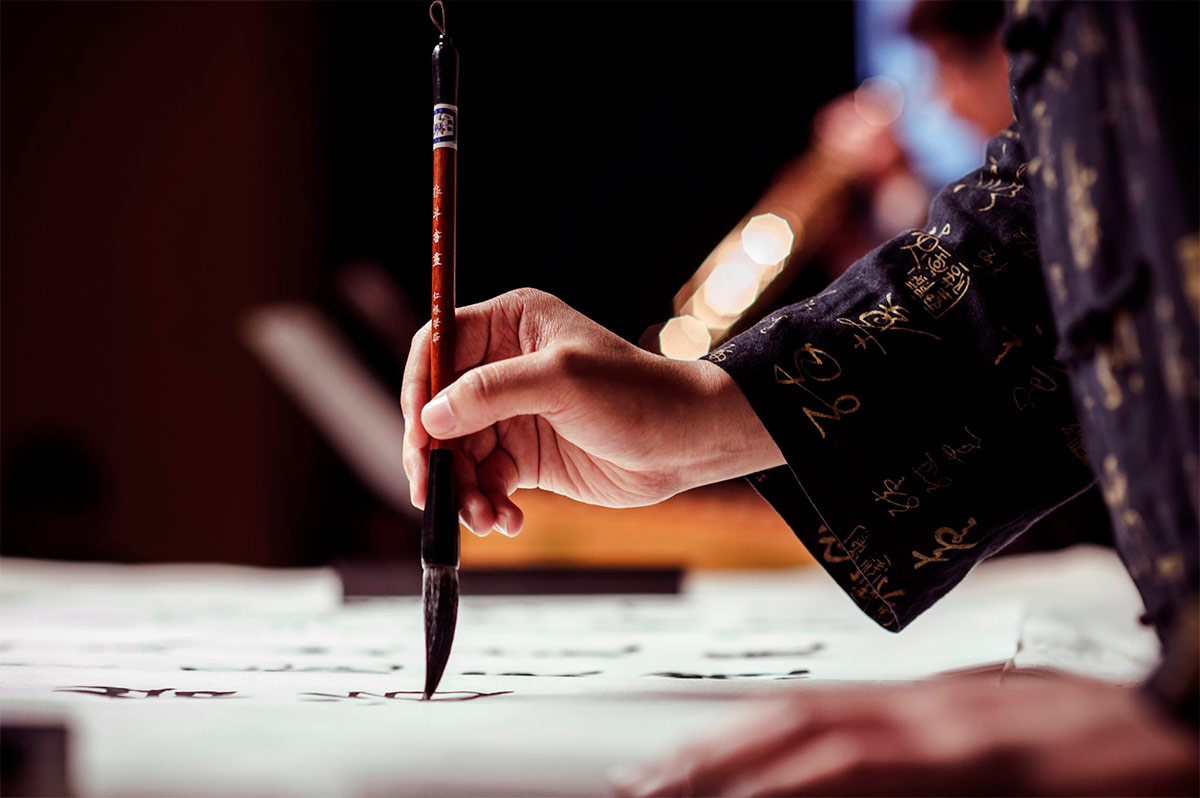
Students will learn the basic strokes of running style. Running style also called semi-cursive script; this is a more flowing style in which strokes are allowed to run into each other.

What does it cover?

Introduce common Chinese soft brush and ink techniques

Guide students through the fundamental strokes of Running & cursive style scripts

Students can anticipate completing at least one piece of Chinese calligraphy artwork per class. The content of this work could be a selected Chinese poem or perhaps an ancient master’s quotation.

Live demonstration will be provided during the class.

About the teacher:

This course will be led by Chi Zhang – an experienced instructor, shortlisted for ‘Sky Art Landscape Artist of the year 2015’, whose work has been projected across Edinburgh castle during the 2015 Military Tattoo. For more information and to see Chi’s work please visit http://www.chizhangartist.com.

How much does it cost?

£85 (£75/concessions), concession is offered only to full time students and UoE staff.

Please also allow up to £25 for materials if you don’t have your own art materials. The tutor will provide guidance on purchasing the materials after registration.

Booking & Further information:

To secure one of the limited spaces on this course, please use the University ePay system .

Due to the outbreak of Covid-19, our administrative team is working from home. Please contact us by email info@confuciusinstitute.ac.uk.

One to one tutorials and small group workshops can also be arranged. Please email info@confuciusinstitute.ac.uk for more info.

5 Week Brush Painting Class – Starts 13 April 2021

Key Information:

Course: Five week Chinese Brush Painting – Lotus and fish (Daytime)

Date & Time: Tuesdays from 13 April – 11 May, 10:00-11:30am

Online teaching time: 7.5 hour

Homework: There will be additional homework after each session and the tutor will also provide individual email feedback, including technical support to deal with relevant queries.

Student level: This course is suitable for both beginners and advanced students.

Class size: A minimum of five students are required to ensure the class goes ahead.

Location: This class will be delivered digitally using the online platform Zoom.

Why should I take this course?

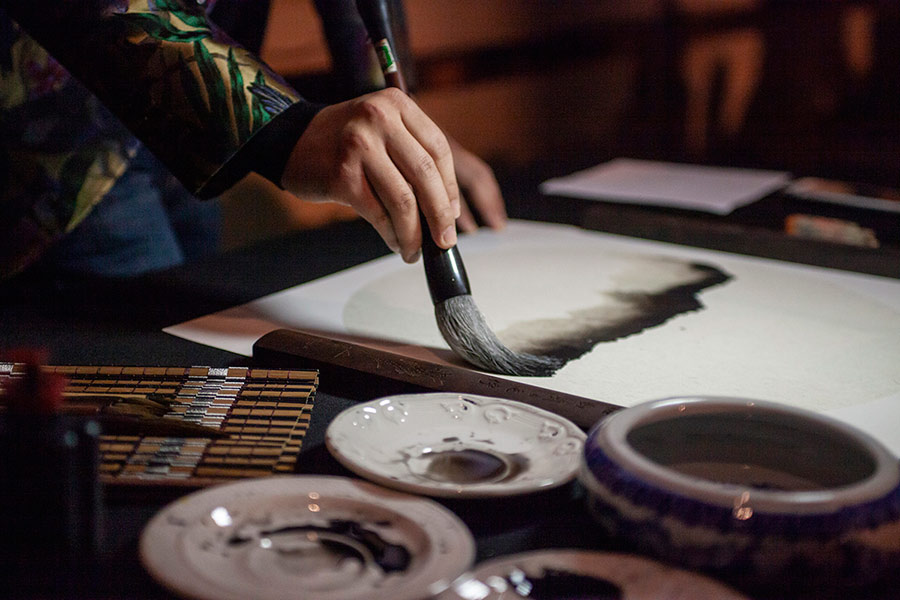
By controlling the special soft brush with a sharp point, Chinese brush painting is not only a mental exercise, also a physical exercise that coordinates the mind and the body. Join this course to learn brush handling techniques and paint some interesting subjects. Lotus represent ultimate purity of the heart and mind and perfection. Koi fish, either black or red, also represent wealth, success and popularity.

What does it cover?

Explore the most common Chinese soft brush and ink techniques.

Live demonstration will be provided during the class.

About the teacher:

This course will be led by Chi Zhang – an experienced instructor, shortlisted for ‘Sky Art Landscape Artist of the year 2015’, whose work has been projected across Edinburgh castle during the 2015 Military Tattoo. For more information and to see Chi’s work please visit http://www.chizhangartist.com.

How much does it cost?

£85 (£75/concessions), concession is offered only to full time students and UoE staff.

Please also allow up to £35 if you don’t have your own art materials. The tutor will provide guidance on purchasing the materials after registration.

Booking & Further information:

To optimise the learning experience a maximum capacity has been set per group – so space is very limited! To secure one of the limited spaces on this course, please use the University’s ePay system.

Due to the outbreak of Covid-19, our administrative team is working from home. Please contact us by email info@confuciusinstitute.ac.uk.

One to one tutorials and small group workshops can also be arranged. Please email info@confuciusinstitute.ac.uk for more info.

EdIntelligence – AI and Data Science Society event – 25 March, 3pm

EdIntelligence, the University AI and Data Science Society, is hosting a talk by Paul Mozur, New York Times Asia Tech Correspondent and Pulitzer Prize finalist, called The Rise of AI in China.

Date and Time: Thursday, 25 March, 2021, 3pm

Location: Online via Zoom

Follow the group’s Facebook event for more details.

Paul Mozur is a technology correspondent focused on the intersection of technology and geopolitics in Asia. He has been twice named a Pulitzer Prize finalist. He has covered China’s innovation boom, the global spread of disinformation on Facebook, the rise of new surveillance technologies and the emerging tech competition between China and the United States.

Paul will provide an insight to the tech environment in China, a region unlike anywhere else in the world and one which has seen greater scrutiny in recent times. The talk will centre around China’s ambitions for their implementation of artificial intelligence and how such progress has been impacted by massive state spending in surveillance. Additionally, in considering the overall landscape, Paul will discuss areas where developments have gone well and where things look rather dystopian.


Asian Studies Seminar – 3 March 2021

You are warmly invited to the next Asian Studies seminar. Prof Sarah Dauncey will give a talk on her new book Disability in Contemporary China: Citizenship, Identity and Culture (Cambridge University Press, 2020), with a dialogue with Prof. Hangping Xu. 

Date and Time: Wednesday 3 March, 4-6 pm (UK time). 

Location: Online via Zoom

Zoom link for registration:

https://ed-ac-uk.zoom.us/meeting/register/tZwkcOuorz8vE9VmUjHoWm92hvDr2N5AP1zt

Abstract: 

In Disability in Contemporary China: Citizenship, Identity and Culture, Sarah Dauncey offers the first comprehensive exploration of disability and citizenship in Chinese society and culture from 1949 to the present. Through the analysis of a wide variety of Chinese sources, from film and documentary to literature and life writing, media and state documents, she sheds important new light on the ways in which disability and disabled identities have been represented and negotiated over this time. She exposes the standards against which disabled people have been held as the Chinese state has grappled with expectations of what makes the ‘ideal’ Chinese citizen. From this, she proposes an exciting new theoretical framework for understanding disabled citizenship in different societies – ‘para-citizenship’. A far more dynamic relationship of identity and belonging than previously imagined, her new reading synthesises the often troubling contradictions of citizenship for disabled people – the perils of bodily and mental difference and the potential for personal and group empowerment.

Speakers bio: 

Sarah Dauncey is Professor of Chinese Society and Disability at the University of Nottingham. Her research focuses on disability in China, in particular the way in which the changing Chinese socio-political environment has transformed the cultural encoding of disability from the end of the Cultural Revolution. Her work has been supported by the British Academy, the Chiang Ching-kuo Foundation, the Universities China Committee in London, the White Rose East Asia Centre and other organisations. She is co-editor of Writing Lives in China, 1600-2010: Histories of the Elusive Self (Palgrave Macmillan, 2013), as well as various book chapters and articles in key Area Studies and Disability Studies journals. Her book Disability in Contemporary China: Citizenship, Identity and Culture was published by Cambridge University Press in 2020. 

Hangping Xu is Assistant Professor at the University of California, Santa Barbara. He specializes in modern and contemporary Chinese literary, cultural, and visual studies, comparative literature, and Taiwan Studies. His interdisciplinary research engages two significant turns in literary and cultural studies—namely, the affective and the ethical —by foregrounding disability as a mode of critique. He is currently completing his first book project entitled Broken Bodies as Agents: Disability Aesthetics and Politics in Modern Chinese Culture and Literature. Probing the narrative and symbolic centrality of disability in the Chinese political-moral imagination of the long twentieth century, it develops a critical genealogy of “Chinese crip figures” in transnational contexts. His publications have appeared in such venues as Modern Chinese Literature and Culture (MCLC), Frontiers of Literary Studies in China, and A Global History of Literature and the Environment (Cambridge University Press). 

The Arrival of “福”

To prepare for the arrival of the Chinese New Year, it is a tradition for every family to thoroughly clean their house to sweep away any ill fortune and make way for incoming good luck.

Decorating windows and doors with red papercutting, couplets and a large upside-down “福” (fú, good luck and blessing) is also a custom. Putting the character upside down relates to a Chinese wordplay. The words for “upside-down” (倒, dào) and “arrive” (到, dào) sound similar in Chinese. So the phrase 福倒了 (fú dào le, “good luck is upside-down”) sounds the same as 福到了 (fú dào le, “good luck is arriving”). Wishing for the arrival of good luck, putting up a “福” on one’s door has become a tradition for many Chinese families. 

Traditionally, “福” is written on square red rice paper with a calligraphy brush. The character can be written in different styles. In this video you can see our calligraphy teacher, Zhang Chi, demonstrating how to write “福” in five different calligraphy styles. (From the right to the left: Seal Style, Clerical Style, Regular Style, Running Style and Cursive Style) 

New Tunes for the New Year

Celebrating the arrival of the Year of the Ox and exploring the ties between China and Scotland, the Institute’s music curator Kimho Ip, together with Filip Davidse, combined the sounds of the traditional Chinese yangqin* and saxophone to create inter-cultural dialogues that reflect the subtle nuances between the cultures. The two new pieces, Winter Is It Past and Delivering Grain, by the Filipkimho Duo were commissioned by the Institute for the Chinese New Year 2021. 

Winter It Is Past by Robert Burns
“Signore ascolta” from Turandot composed by Giacomo Puccini
Arranged by Kimho Ip

The Italian composer Puccini was inspired by Chinese tunes in his opera, Turandot. The duo has been inspired by their numerous performances in Scotland, including working with Scottish folk musicians. Winter It is Past is a piece that evokes fond memories of their time here in Scotland.

Delivering Grain 
Composed by Gu Wuxiang
Arranged by Kimho Ip

The piece was originally written for the erhu* during the 1970s Cultural Revolution. The lively atmosphere of the music reflects China’s agricultural society and the determination to achieve modernisation. The arrangement and the video attempt to recontextualize the piece in the 21st century, documenting the two musicians and their cycling journeys in Amsterdam delivering music to audiences in Europe.

*The yangqin 扬琴 is considered a traditional Chinese stringed instrument – despite being played percussively using tipped bamboo beaters. Like other Hammered Dulcimers before it, the yangqin is thought to have originated in the Middle-East before being introduced into Africa, Europe and finding its way to China toward the latter end of the Ming dynasty (1368-1644CE). The original name used a different “yang” 洋  which was commonly associated with things foreign in origin or nature.

The erhu 二胡 is a two-stringed instrument played with a bow. Made popular as an accompanying instrument in traditional Chinese opera there are several slight variations in size and pitch. The erhu is thought to have first appeared in China during the Tang Dynasty (618-907CE).

Kimho Ip and Filip Davidse

Chinese New Year of the Ox

Determination, resilience and faith are embodied in the zodiac animal for the coming year. As the Year of the Ox approaches, we hope the new year will inspire us all to tackle the challenges that still remain head on. 

Join the Confucius Institute for Scotland and the team virtually for a range of activities to mark the arrival of the Year of the Ox which starts on 12 February 2021. Don’t miss your Chinese New Year essentials, including how to prepare for the Chinese New Year, how to write 福 (fú, luck),  say Chinese New Year greetings or wrap the traditional delicacy 饺子 (jiaǒzi, dumplings). Although we cannot gather together to celebrate the New Year together, we hope to bring you a flavour of the celebration online.

THE CHINA-SCOTLAND BUSINESS AWARDS AND CHINESE BURNS SUPPER 2021

15.30-17.00, 4 February 2021 on Zoom

The Confucius Institute for Scotland is working with the China Britain Business Council Scotland once again this year on the unique Chinese Burns Supper event where we celebrate the two cultures and heritages together. This online event is free and you can register for it .  

NEW TUNES FOR THE NEW YEAR

Launch on the Chinese New Year’s Day, 12 February 2021

Celebrating the arrival of the Year of the Ox and exploring the ties between China and Scotland, the Institute’s music curator Kimho Ip, together with Filip Davidse, combined the sounds of the traditional Chinese yangqin and saxophone to create inter-cultural dialogues that reflect the subtle nuances between the cultures. The two new pieces, Winter Is It Past and Delivering Grain, by the Filipkimho Duo were commissioned by the Institute for the Chinese New Year 2021. 

VIRTURAL EVENT: A GLIMPSE INTO CHINESE NEW YEAR

13.00-14.00, Tuesday, 16 February or 17.00-18.00, Friday, 19 February on Zoom 

Join this fun-filled quiz and game session to learn more about the Chinese New year. Combining language and culture activities, this session celebrates the traditional Chinese New Year and covers all the basics about the Chinese New Year. 

The event is free and family friendly, but booking essential. Please reserve your place at Eventbrite.

The Confucius Institute for Scotland wishing you a healthy, peaceful and fulling new year 2021! 


5 Week Calligraphy Class – Starts 3 March 2021

calligraphy

Key Information:

Course: Five week Chinese Calligraphy (Daytime)

Date & Time: Wednesdays from 3 March – 31 March, 10:00-11:30am

Online teaching time: 7.5 hour

Homework: There will be additional homework after each session and the tutor will also provide individual email feedback, including technical support to deal with relevant queries.

Student level: This course is suitable for both beginners and advanced students.

Class size: A minimum of five students are required to ensure the class goes ahead.

Location: This class will be delivered digitally using the online platform Zoom.

Why should I take this course?

Clerical scripts (隶书, lìshū) is a traditional artistic writing format dated back 2000 years ago and still widely used in signage and headings nowadays. This writing style is easier to learn and suitable for beginners.

What does it cover?

  • Introduce common Chinese soft brush and ink techniques
  • Guide students through the fundamental strokes of Seal and Clerical style scripts
  • Students can anticipate completing at least one piece of Chinese calligraphy artwork per class. The content of this work could be a selected Chinese poems or perhaps an ancient master’s quotation.
  • Live demonstration will be provided during the class.

About the teacher:

This course will be led by Chi Zhang – an experienced instructor, shortlisted for ‘Sky Art Landscape Artist of the year 2015’, whose work has been projected across Edinburgh castle during the 2015 Military Tattoo. For more information and to see Chi’s work please visit http://www.chizhangartist.com.

How much does it cost?

£85 (£75/concessions), concession is offered only to full time students and UoE staff.

Please also allow up to £25 for materials if you don’t have your own art materials. The tutor will provide guidance on purchasing the materials after registration.

Booking & Further information:

To secure one of the limited spaces on this course, please use the University ePay system .

Due to the outbreak of Covid-19, our administrative team is working from home. Please contact us by email info@confuciusinstitute.ac.uk.

One to one tutorials and small group workshops can also be arranged. Please email info@confuciusinstitute.ac.uk for more info.

Booking Deadline:

Please note bookings will close 7 days before the term start date.

5 Week Brush Painting Class – Starts 2 March 2021

Key Information:

Course: Five week Chinese Brush Painting – Birds and Flowers (Daytime)

Date & Time: Tuesdays from 2 March – 30 March, 10:00-11:30am

Online teaching time: 7.5 hour

Homework: There will be additional homework after each session and the tutor will also provide individual email feedback, including technical support to deal with relevant queries.

Student level: This course is suitable for both beginners and advanced students.

Class size: A minimum of five students are required to ensure the class goes ahead.

Location: This class will be delivered digitally using the online platform Zoom.

Why should I take this course?

Birds and flowers painting were often used as decorative elements in pottery, appeared in screens and utensils. From Tang dynasty around the 8th and 9th centuries in China until today, Birds and flowers painting is a special school of Chinese brush paintings and it is widely popular for centuries.

What does it cover?

  • Explore the most common Chinese soft brush and ink techniques
  • Participants will have the option to select from a range of subjects demonstrated by the tutor, such as crane, oriole, kingfisher, lotus flower, Chinese orchid etc.
  • Live demonstration will be provided during the class.

About the teacher:

This course will be led by Chi Zhang – an experienced instructor, shortlisted for ‘Sky Art Landscape Artist of the year 2015’, whose work has been projected across Edinburgh castle during the 2015 Military Tattoo. For more information and to see Chi’s work please visit http://www.chizhangartist.com.

How much does it cost?

£85 (£75/concessions), concession is offered only to full time students and UoE staff.

Please also allow up to £35 if you don’t have your own art materials. The tutor will provide guidance on purchasing the materials after registration.

Booking & Further information:

To optimise the learning experience a maximum capacity has been set per group – so space is very limited! To secure one of the limited spaces on this course, please use the University’s ePay system.

Due to the outbreak of Covid-19, our administrative team is working from home. Please contact us by email info@confuciusinstitute.ac.uk.

One to one tutorials and small group workshops can also be arranged. Please email info@confuciusinstitute.ac.uk for more info.

Booking Deadline:

Please note bookings will close 7 days before the term start date.

The China-Scotland Business Awards and Chinese Burns Supper 2021

The Confucius Institute for Scotland is working with the China Britain Business Council Scotland once again this year on the unique Chinese Burns Supper event where we celebrate the two cultures and heritages together.

Although we have to celebrate the great Scottish poet, Robert Burns and Chinese New Year virtually this year, we hope this opportunity will show a wider community the rich and vibrant ties in both business and culture that connect us.

The China-Scotland Business Awards 2021 will also be announced at the event. Find more about the shortlisted candidates for awards on the China Britain Business Council website

Join us on 4th February for the China-Scotland Business Awards and Chinese Burns Supper 2021. This online event is free and you can register the event .  

5 Week Calligraphy Class – Starts 20 January 2021

calligraphy

This class will be delivered digitally using the online platform Zoom. To optimise the learning experience a maximum capacity has been set per group – so space is very limited!

This five week course takes place on Wednesday mornings from 20 January to 17 February 2021, and will be led by Chi Zhang, the Institute’s experienced calligraphy teacher. Under his expert guidance, countless students have discovered the joy of practicing the ancient arts of calligraphy and painting using the Chinese brush.

This course will start by introducing common Chinese soft brush and ink techniques, before guiding students through the fundamental strokes of Regular and Running style scripts.

Regular script(楷书, kǎishū) is most common in modern writing and publications, and requires several individual strokes and stops to produce one perfectly formed character. Running script(行书, xíngshū), also known as semi-cursive script, is a more flowing style in which the individual strokes within a character are allowed to run into one another.

Students can anticipate completing at least one piece of Chinese calligraphy artwork per class. The content of this work could be a selected Chinese poems or perhaps an ancient master’s quotation. This course is suitable for both beginners and advanced students.

Live demonstration will be provided during the class. There will be additional homework after each session and the tutor will also provide individual email feedback, including technical support to deal with relevant queries.


The fee is £85 for this 7.5 hour course, running on Wednesday mornings between 10:00am – 11.30am, from 20 January 2021. There is a concession rate of £75 which is offered only to full time students and UoE staff.

Please also allow up to £25 for materials if you don’t have your own art materials. The tutor will provide guidance on purchasing the materials after registration. A minimum of five students are required to ensure the class goes ahead.

To secure one of the limited spaces on this course, please use the University ePay system .

This course will be led by Chi Zhang – an experienced instructor, shortlisted for ‘Sky Art Landscape Artist of the year 2015’, whose work has been projected across Edinburgh castle during the 2015 Military Tattoo. For more information and to see Chi’s work please visit http://www.chizhangartist.com.

Due to the outbreak of Covid-19, our administrative team is working from home. Please contact us by email info@confuciusinstitute.ac.uk.

Key Information

Course: Five week Chinese Calligraphy Class (Daytime)
Date & Time: Wednesdays from 20 January – 17 February, 10:00-11:30am.
Cost: £85 (£75/concessions)
Location: Online via Zoom

One to one tutorials and small group workshops can also be arranged. Please email info@confuciusinstitute.ac.uk for more info.

5 Week Landscape Brush Painting Class – Starts 19 January 2021

Landscape Brush Painting

This class will be delivered digitally using the online platform Zoom. To optimise the learning experience a maximum capacity has been set per group – so space is very limited!

‘The unique style of Chinese landscape painting was developed more than a thousand years ago, and has been honed to perfection by generations of master painters.’ Landscape, literally translated as ‘mountain and water’ (山水, shānshuǐ), is one of the most popular subjects in Chinese brush painting.

This 5 week course will start by introducing the history of Chinese landscape painting, before exploring the most common Chinese soft brush and ink techniques. Participants will have the option to select from a range of subjects demonstrated by the tutor.

Live demonstration will be provided during the class. There will be additional homework after each session and the tutor will also provide individual email feedback, including technical support to deal with relevant queries. This course is suitable for both beginners and advanced students.

The fee is £85 for this 7.5 hour course, running on Tuesday mornings between 10.00am – 11.30pm, from 19 January 2021. There is a concession rate of £75, which is offered only to full time students and UoE staff.

Please also allow up to £35 if you don’t have your own art materials. The tutor will provide guidance on purchasing the materials after registration. A minimum of five students are required to ensure the class goes ahead.

To secure one of the limited spaces on this course, please use the University’s ePay system.

This course will be led by Chi Zhang – an experienced instructor, shortlisted for ‘Sky Art Landscape Artist of the year 2015’, whose work has been projected across Edinburgh castle during the 2015 Military Tattoo. For more information and to see Chi’s work please visit http://www.chizhangartist.com.

Due to the outbreak of Covid-19, our administrative team is working from home. Please contact us by email info@confuciusinstitute.ac.uk.

Key Information

Course: Five week Chinese Brush Painting – landscape (Daytime)
Date & Time: Tuesdays from 19 January – 16 February 2021, 10:00-11:30am
Cost: £85 (£75/concessions)
Location: Online via Zoom

One to one tutorials and small group workshops can also be arranged. Please email info@confuciusinstitute.ac.uk for more info.

Lecture on Chinese studies on digital humanities: 11 Nov, 2-3PM

A Distant Exploration of Literary Writings and Historical Documents in Classical Chinese

Date and Time: 11 Nov, Wednesday, 2-3 pm

Speaker: Prof Chao-lin Liu, National Chengchi University, Taiwan

Chair: Dr Christopher Rosenmeier, University of Edinburgh

Zoom link for registration:

https://ed-ac-uk.zoom.us/meeting/register/tZAqduCqpjsiHNO2QW8Fvp0ktYATr0H3MAuy

Abstract:

We design and employ software to analyze the contents of literary writings and historical documents. In the burgeoning stage of digital humanities in Taiwan, relatively simple yet interesting analysis of famous novels of Ming and Qing dynasties were used to stimulate the interests in digital humanities of the humanities researchers. Gradually, we move onto more practical analysis of the poetic works of the Tang and Song dynasties. Methods of text analysis assist us to look for useful information in historical documents in both classical and modern Chinese, and part of which represents our collaboration with the China Biographical Database Project of Harvard University. In recent years, we apply similar methods to analyze Taiwanese poems and local gazetteers. More recently, we extend our efforts to optical character recognition to digitise hard copies of classical Chinese texts. Aiming at achieving a more advanced level of algorithmic competence, we also explore the applicability of deep learning methods to the problems of word segmentation for classical Chinese poems and the problems of sentence splitting for historical documents that were also written in classical Chinese. We shall share selected experience in this brief presentation.

About the speaker:

Prof. Chao-lin Liu obtained his Ph.D. from the Institute of Electronic Engineering and Computer Science, University of Michigan. His research focuses on data analysis and knowledge exploration, digital humanities, computational linguistics.  Now he is the Professor and Chairperson of the Department of Computer Science and the Associate Dean of the College of Science, National Chengchi University.  Prof. Liu is the incumbent president of the Taiwanese Association for Digital Humanity.

Please pre-register here:   

https://ed-ac-uk.zoom.us/meeting/register/tZAqduCqpjsiHNO2QW8Fvp0ktYATr0H3MAuy

This lecture is hosted by Asian Studies & the University Library, University of Edinburgh, National Central Library of Taiwan and Centre for Chinese Studies, Taiwan. 

Chinese Science Fiction as World Literature: 21 Oct, 2-4pm

You are warmly invited to the next Asian Studies seminar, a roundtable discussion on the topic of “Chinese Science Fiction as World Literature.” The event will be taking place via Zoom on Wednesday 21 Oct, 2-4 pm (UK time). All are warmly welcome to join a discussion with the acclaimed authors and leading scholars in the field!

Abstract:

Following the global success of Liu Cixin’s The Three-Body Problem, contemporary Chinese science fiction has attracted much attention internationally, emerging as a cultural phenomenon in World Literature. 21st century Chinese science fiction authors are not only writing for their domestic readership, but also navigating a global cultural market and a transnational fan network. The fantastical, imaginative worlds of Chinese science fiction open up a unique window for understanding contemporary Chinese society, its past and future, as well as its position in the global world and even the universe.

This roundtable brings together acclaimed writers and prominent scholars for an engaging dialogue on the production and reception of Chinese science fiction, its historical dimensions, and the ways in which Chinese sci-fi informs debates on political, social, and cultural change around the globe.

Speakers:

Chen Qiufan 陈楸帆 is a science fiction writer, screenwriter, and columnist. He is the recipient of many literary awards, including the Gold Award for Best Novel at the 2013 Chinese Nebula Awards competition for his novel Waste Tide. English versions of his works have appeared in Clarkesworld, Pathlight, Lightspeed, as well as in anthologies of Chinese speculative fiction such as Invisible Planets and Broken Stars.

Gu Shi 顾适 is a science fiction writer and an urban planner. She won a Gold Award for Best Novella at the Chinese Nebula Awards competition in 2016, and her short story “Möbius Continuum” won a Galaxy Award for Best Short Story in 2017. Her works have been translated into English and feature in Clarkesworld, Broken Stars, and an anthology of Chinese speculative fiction edited by Ken Liu.

Dr Heather Inwood is University Lecturer in Modern and Contemporary Chinese Literature and Culture at the University of Cambridge. Her research has focused on interactions between media, literature and culture in contemporary China. She is the author of Verse Going Viral: China’s New Media Scenes (2014) and many academic essays. She has written Chinese-language columns for newspapers, websites and magazines in the UK and China.

Dr Nathaniel Isaacson is an Associate Professor of Modern Chinese literature and cultural studies at North Carolina State University. He is the author of Celestial Empire: the Emergence of Chinese Science Fiction (2017), and his essays on Chinese Science Fiction have appeared in Science Fiction Studies, and other journals and volumes. He is also the translator of Chinese science fiction by Hao Jingfang, Han Song, and others.

Discussant:

Professor Aaron Moore is Handa Chair of Japanese-Chinese Relations at the University of Edinburgh. He is a transnational and comparative social historian, and he is also conducting research on the long history of science writing and speculative fiction. He is the author of Bombing the City: Civilian Accounts of the Air War in Britain and Japan, 1939–1945 (2018), Writing War: Soldiers Record the Japanese Empire (2013), and many other essays.

Please pre-register here:

https://ed-ac-uk.zoom.us/meeting/register/tZApcuGtqTkjGtF8pVvtZ33nwb6RrMkqkTva

(Registration will close at 12 noon, 21 Oct.)

Language Research Project – Call For Participants

On behalf of Brittany Blankinship, PhD researcher, University of Edinburgh

We are a team of researchers looking at the effects of language learning on cognitive functions. As you’ll be learning a language, we’d like to invite you to participate in this research! We would also be happy to send you information about the results of the project after it is completed!
It’s a simple experiment in which you will be asked to respond to a series of sounds. We’ll also have you fill in a very short questionnaire about your language background and language attitudes and complete a short computer-based task. In total, it takes 20-30 minutes and will be carried out at the beginning and end of your course to see whether any changes have occurred.

All aspects of the research will be conduct online. Should you wish to participate, you will be sent an online link to a questionnaire and asked to schedule a short video call with a researcher to complete the experiment.

If you are interested in participating or would like to know more about this project, please get in touch with Clea at her email address c.r.strathmann@sms.ed.ac.uk. We would greatly appreciate it if you helped us understand how learning languages affects cognition!

Asian Studies Seminar Series (online), Friday 2nd Oct, 4-6pm.

seminar series

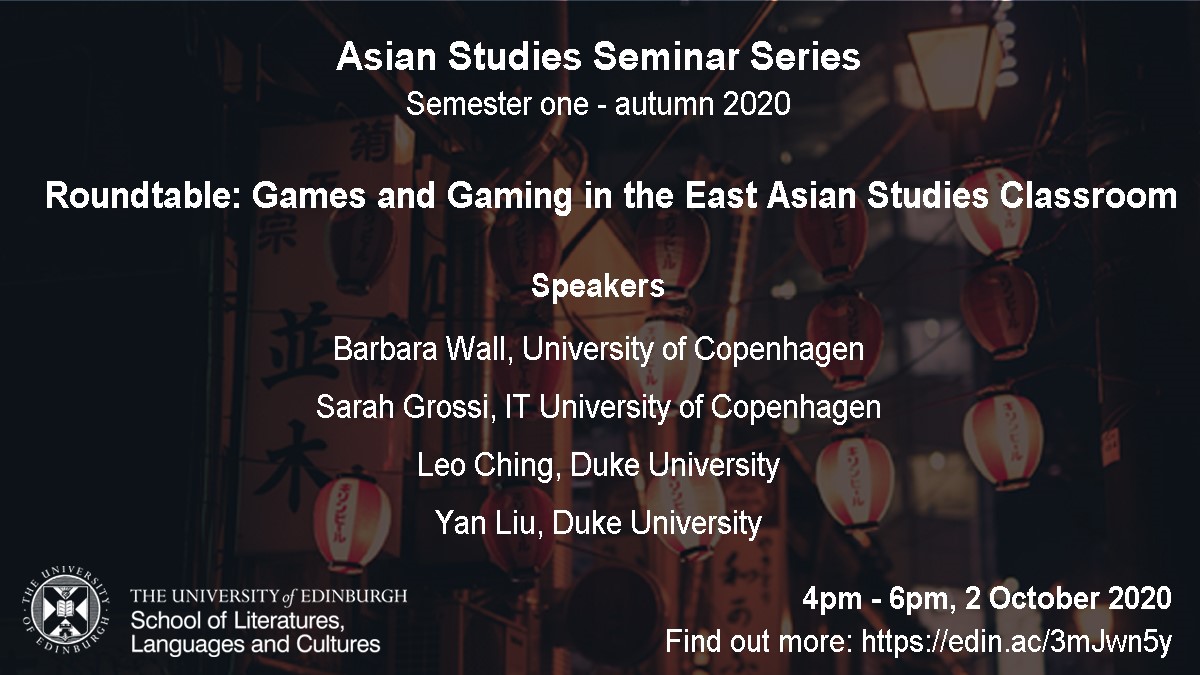
You are warmly invited to the first of the Asian Studies Seminar Series events for this semester on Friday 2 October, 4-6pm (UK time), when we will be hosting a roundtable discussion on the topic of “Games and Gaming in the East Asian Studies Classroom.”

Abstract:

East Asia has been at the forefront of many developments in the gaming industry—currently one of the fastest growing industries in the world. From the design and production of consoles and games to the professionalization of e-sports and the social implications of gaming cultures, both positive and negative, East Asia has pioneered numerous global trends. As much as games can serve as a lens onto contemporary East Asian cultures and societies, however, they can also provide a pedagogical tool to inspire deeper engagement with historical texts and events as well as innovative methods for language learning.

This roundtable will examine how, as scholars and students of East Asia, we approach games and gaming in the classroom, with speakers sharing their own experiences of teaching about East Asia with and through games.

Speakers:

Barbara Wall, University of Copenhagen

Sarah Grossi, IT University Copenhagen

Leo Ching, Duke University

Yan Liu, Duke University

Registration: 

The roundtable will be hosted on zoom. All are welcome to attend, but please pre-register here for access to the event: https://ed-ac-uk.zoom.us/meeting/register/tJErde-rqjItHNF4j6ZKU_yDidfNeaPUW2mz

“Chinese Bridge • Global Music” International Music Talent Video Competition

Music Talent all around the world, both professionals and armatures, are warmly invited to join this online video competition organised by Central Conservatory of Music (CCOM) in China.

This competition is designed for Chinese language learners to show case their music talent by recording a music performance piece featuring Chinese elements. There are three categories in this competition: Instrument, Vocal or Original Work.

Winners of the competition will have the opportunities to perform at an online concert and will be awarded a scholarship to attend “Chinese Music Culture” International Summer Camp in China. Accommodation and travel expenses in China during the summer camp will be covered and additional funding of international flight tickets will be on offer.

Technical requirements:

The video submission should be no longer than 5 minutes and it should be a continuous one take without any post-production editing. The video should be in MP4 format or other common formats.

Submission:

The video should be submitted to mtvc2020@126.com copying info@confuciusinstitute.ac.uk no later than 10th Oct 2020 (Beijing Time) with the following subject: Video Competition + Name of your work. You should also submit a photo and a brief introduction of yourself (no more than 300 words, in either Chinese or English) at the same time.

Due to the size of the video, we recommend you to use WeTransfer to send your work and self-introduction.

For further details of the competition, please visit: https://mp.weixin.qq.com/s/MYRagCWa4VTMPwfb6jczAQ

We look forward to receiving your submission in due time

“Chinese Bridge” Chinese Proficiency Competition UK Final – Saturday 19 September

Chinese Bridge is the biggest global Chinese language competition in the world with regional qualifier competitions running all over the world. The public performance tests the contestants on their Chinese language ability, knowledge of China, Chinese cultural skills and understanding. Contestants often showcase their skills in music, martial arts, or comedy chops. Winners at the UK competition will have the opportunity to join the global final with contestants all around the world.

The upcoming UK regional 19th “Chinese Bridge” Chinese Proficiency Competition will take place on Saturday, 19th September 2020. It will run digitally this year due the Covid-19 pandemic. This opens up opportunities for people to observe the competition online. To register, please scan the QR code on the invitation below.

chinese bridge

Edinburgh has a great track record from previous competitions.  This year Owen Wilson, an undergraduate student studying joint honours in Chinese and Spanish will represent University of Edinburgh in the competition. As part of the competition, Owen made a short video to introduce himself and his typical day under the lock-down.

We send best wishes to Owen and to his tutors this year!

Online Lecture – Paola Subacchi

Our friends at the Scotland China Education Network will be hosting Paola Subacchi to deliver her online lecture “Cooperation or competition — China in the post-Covid world economy”.

The event will be held via Zoom this Thursday, 10 September from 7pm.


Paola Subacchi is an economist, writer and commentator on the functioning and governance of the international financial and monetary system.

She is Professor of International Economics and Chair of the Advisory Board of the Global Policy Institute at Queen Mary University of London, a visiting professor at the University of Bologna, non-executive director of Scottish Mortgage Investment Trust PLC as well as the founder of Essential Economics Ltd.

She writes regularly on Project Syndicate and is the author of The Cost of Free Money: How Unfettered Capital Threatens Our Economic Future (Yale University Press, 2020) and The People’s Money: How China is building a global currency (Columbia University Press, 2017).

An Italian national, she studied at Università Bocconi in Milan and at the University of Oxford. She was awarded the honour Cavaliere della Stella d’Italia in 2016.


If you are interested in joining, please contact admin@scen.info for more information. 

Vacancy – Confucius Institute Teaching Fellow in Chinese

The Confucius Institute for Scotland is seeking to appoint a full-time teaching fellow in Chinese. This is a fixed-term appointment, available until 1 August 2021.

For more information, and to apply, please click here and use Vacancy Reference: 053051

Closing Date: 5 October, at 5 pm.