
Distinguished Lecture: Yuri Pines 17 March 6pm

Empire without Emperors?
Rethinking aspects of China’s “modernization”

China’s republican revolution of 1911 is overwhelmingly considered— notwithstanding ongoing debates over its nature, course, and outcomes—a necessary and positive step on the country’s path toward social and political “modernization.” Yet if viewed in the context of traditional Chinese political culture, the haphazard abolition of the millennia-old monarchic form of rule appears as less prudent.

In this talk Professor Pines will address short- and long-term repercussions of China’s transformation from a monarchy into a republic and reassess its political and cultural consequences. A renewed analysis of advantages and disadvantages of China’s abolition of monarchic rule may be of interest to historians of traditional and modern China and also of some relevance to those concerned with China’s ongoing attempts to redefine its cultural image.

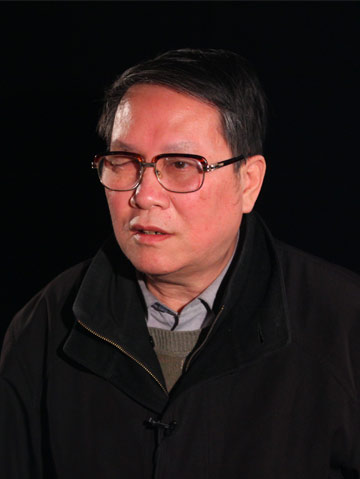
Professor Yuri Pines

yuriBorn in Kiev, Ukraine, in 1964 Yuri Pines works at the Hebrew University of Jerusalem. His research focuses on political thought of pre-imperial (pre-221 BCE) China and on the political culture of imperial China. He is also involved in studies of political, social, and religious history of pre-imperial and early imperial (Qin) China and of early Chinese historiography.

His major monographs include The Everlasting Empire: Traditional Chinese Political Culture and Its Enduring Legacy (Princeton, 2012); Envisioning Eternal Empire: Chinese Political Thought of the Warring States Era and Foundations of Confucian Thought: Intellectual Life in the Chunqiu Period (Honolulu: University of Hawai’i Press, 2009 and 2002). His new study, The Book of Lord Shang: Apologetics of State Power in Early China is forthcoming in Columbia University Press, 2017.

For further details see http://www.eacenter.huji.ac.il/Pines and https://huji.academia.edu/yuripines

This Distinguished Lecture from Professor Pines will take place in Lecture Theatre 2 at the University of Edinburgh’s Business School from 6pm on Thursday 17th March.   Following on from the lecture and Q&A there will be a networking drinks reception.

No booking is required.

DiaoChan: The Rise of the Courtesan, Cumbernauld Theatre

Often called the Chinese Macbeth, DiaoChan is an epic story of lust, jealousy and revenge, taken from the ancient Chinese classic The Romance of the Three Kingdoms.

After the success of last year’s production of The Autumn of Han, Red Dragonfly Productions is delighted to return with another exciting theatre adaptation of a Chinese classic ‘DiaoChan: The Rise of the Courtesan’ at:

Cumbernauld Theatre, Kildrum, Cumbernauld, North Lanarkshire G67 2BN

On Saturday 5 March 2016, 7.45pm

http://www.cumbernauldtheatre.co.uk/events/diaochan-a-chinese-legend/

The play is performed in English and in colourful traditional Han costumes. It is also suitable for 12+. The show is entertaining and accessible, and has been well received by audiences so far, proving popular with English speaking theatregoers, students and academics, and Chinese communities.

‘A wonderful experience to explore the culture and traditions of ancient China through their own mythology, in a manner that will appeal to everyone.’ “British Theatre Guide on The Autumn of Han at Edinburgh Fringe Festival

Should you have any enquiries or would wish to get group tickets/discounts, please contact the Red Dragonfly Productions by email: mic.reddragonfly@gmail.com or mobile tel: 07833538318.

Visit their website at www.reddragonflyproductions.co.uk

We look forward to seeing you in Cumbernauld.

Asian Studies Seminar Series 2nd March

The second of the three Chinese Studies Research Seminars will take place on Wednesday, March 2nd 2016 in David Hume Tower, LG.08 from 17.00-19.00

Dr Sabrina Yu (Newcastle University)
Going Back to the Hometown: A New Root-searching Movement in Contemporary Chinese Independent Cinema

It has been critically recognised that there was a root-searching movement in the 1980s in China, immediately after the Cultural Revolution, firstly in literature, then in film, exemplified by some Fifth Generation Directors’ works. This paper aims to outline a new root-searching movement emerging in Chinese independent films in the past ten years or so.

It will scrutinise this new trend within its social, cultural and filmic context in contemporary China. The speaker will argue that this new root-searching movement is different from the previous one in that root-searching is not just a subject matter or a nostalgic sentiment, but also manifested as new film aesthetics and fresh approaches to filmmaking, which have been subtly changing the landscape of contemporary Chinese cinema. This new trend will also be discussed in relation to the challenges that independent filmmaking in current China is facing, such as the lack of financial support, the restrictions on exhibition and distribution and the scarcity of audience.

Third Talk 16th March 2016

The third talk of the series this semester will take place on March 16th and will be given by Dr Liang Hongling (University of Glasgow) on “The Enlightenment, Sino-French Institute and Tel Quel: Looking at Three Moments in Sino-French Knowledge Dynamics”.

5 week/10 hour Calligraphy Course-with Chinese Proverbs: from 10 May

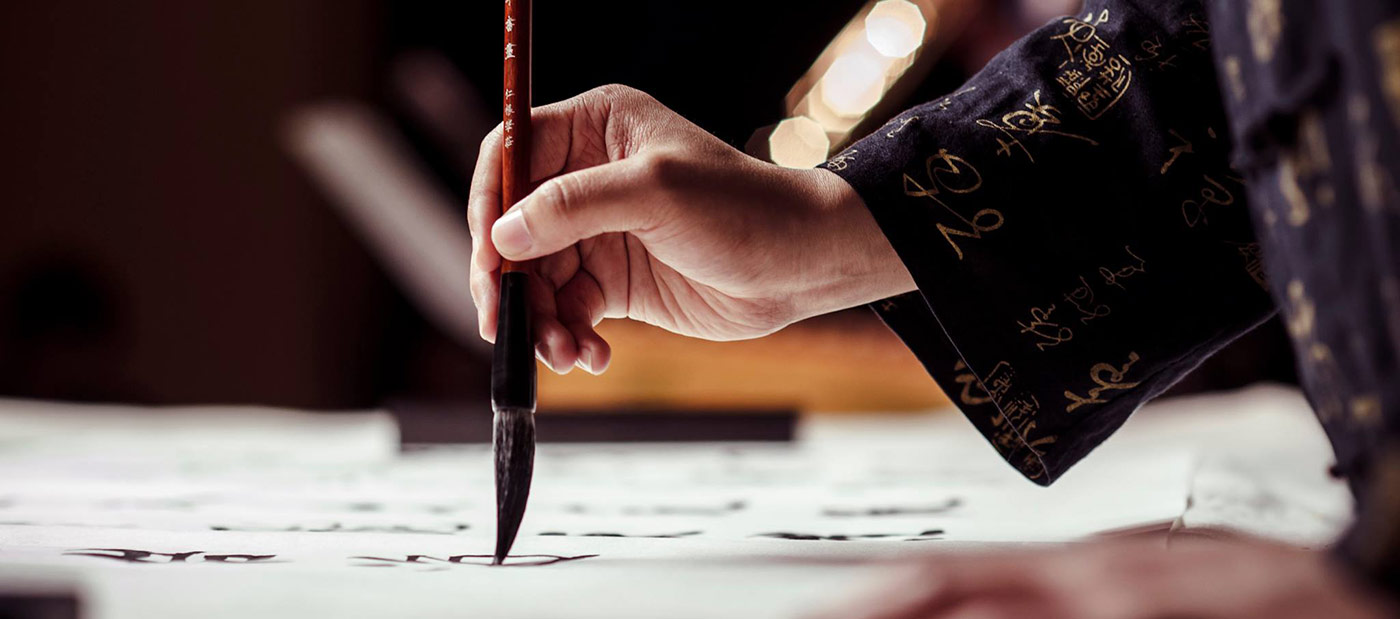
Take the chance to try your hand at the ancient Chinese arts of calligraphy and brush painting in a short five week/10 hour course taught by the Institute’s well known calligraphy teacher Chi Zhang.

Running every Tuesday evening from 10 May till 7 June this short course, focusing on Chinese characters, will introduce common techniques related to Chinese soft brushes and ink. Students will learn the basic strokes of Regular Style (Kai Shu), the radical parts and gain cultural understandings relating to the structure of Chinese characters.

Students can anticipate completing at least one piece of Chinese calligraphy artwork per class. The contents of this work could be a selected Chinese proverb or perhaps an ancient master’s quotation. Demonstration and plenty of personal attention will be provided during the class. This course is suitable for both beginners and advanced students.

There will be a maximum of 10 students in the class for which all materials are provided. The cost is £75 for 10 hours or £60 for concessions. Minimum enrolment of 5 is required to ensure the class goes ahead.

To book a place on this rewarding course please complete and return the registration form below along with your cheque payment made out to the University of Edinburgh.  Cash payment can be made at the Institute office

Spring2016-CalligRegFormHalfTerm

literature

HSK Online Registration closes next week 3 March

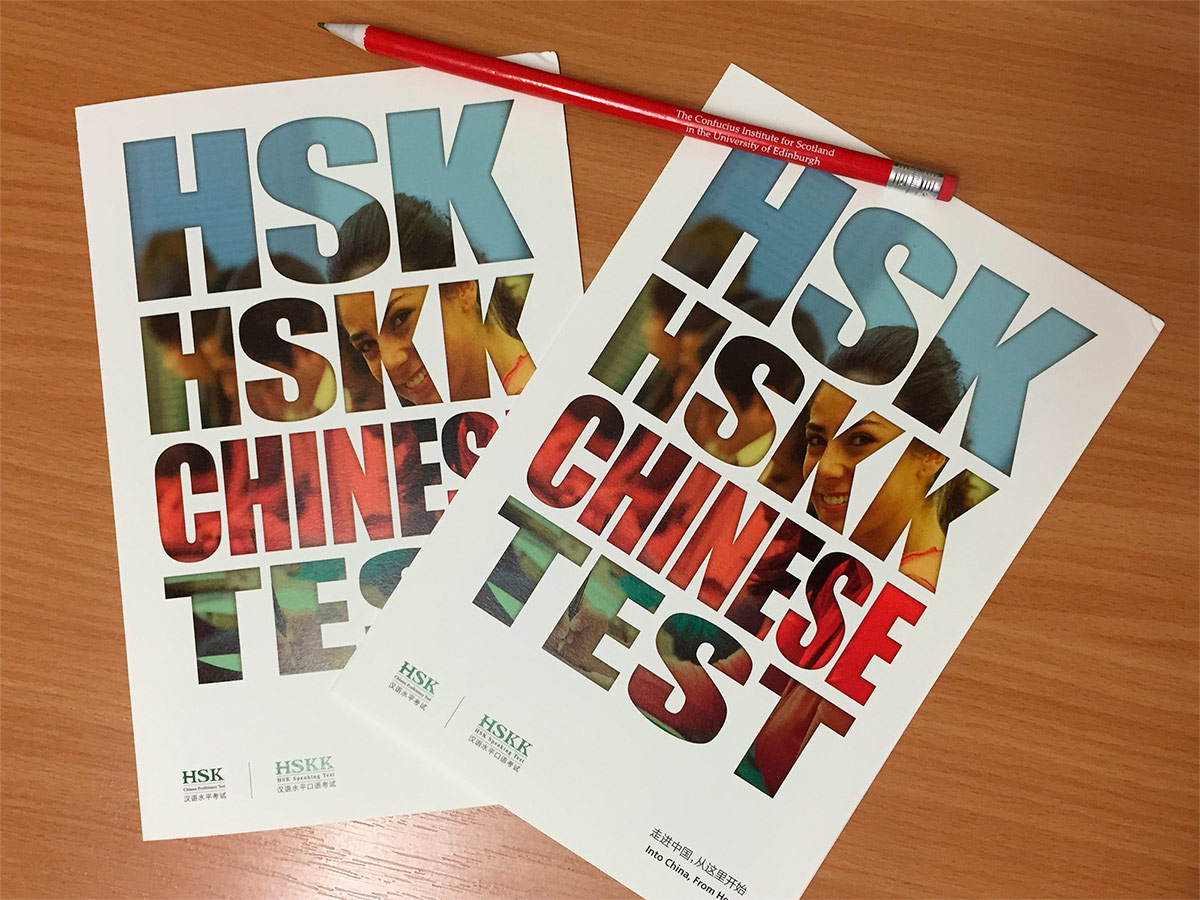
The registration deadline for the HSK March Online Exam will close on Thursday 3rd March 2016. Applicants should download, complete and return the registration form by this date.  For full details please see the HSK information section on our website.  The registration form is available here HSKapplformMarchExam2016 or on the HSK section of our site.

The next exam diet for HSK and HSKK (the oral component of the exam) will be Saturday 21 May.  Registration deadline for the offline May exam is Thursday 21 April while the online exam deadline is Thursday 5 May. The preparatory workshop will take place on Saturday 7 May.

For more details about HSK please visit the HSK information section on our website.

Chinese language teachers for Scottish schools – opportunity

The British Council’s Chinese Language Assistant programme for UK schools is now seeking applications.  If your school would like to secure a Chinese Language Assistant for the 2016/17 academic year please read on then apply via the British Council website by 31 March 2016.

Chinese language assistants work in UK schools to support an existing Mandarin provision or introduce the language and culture to students for the first time. Their role can be tailored depending on the requirements of the school – or indeed a group of up to three schools or further education colleges.  A short summary of the scheme is below.

  • You can employ a language assistant to work a minimum of 12 hours per week and a maximum of 18 hours per week.
  • It is not possible to offer a language assistant a lower allowance in return for fewer hours.

Thanks to support from Hanban, sponsor of the global Confucius Institute network, the cost to schools taking on a Chinese language assistant drop from £13.29 to only £7.20, the National Living Wage. This means the average annual costs for a Chinese language assistant working 12 hours per week for 41 weeks would be just under £3800 (inclusive of the £200 IHS fee).

Full details of the scheme are available on the British Council’s website.   Good luck!

Are you looking to work in China?

The British Council is now offering graduates the opportunity to work for ten months in universities and schools across China. But be quick – the application deadline is fast approaching! (21 February 2016)

Working as a language assistant is the perfect opportunity to spend time learning Mandarin, whilst developing invaluable transferable skills. Plus, you’ll get paid.

With teaching time limited to between 12 and 20 hours a week, being a Language Assistant gives you plenty of time to explore China and develop your language skills. Previous participants have made the most of this free time – by setting up their own business or even appearing on Chinese TV!

During your placement in China, you’ll get:

  • support from the British Council, with over 35 years’ experience working in China
  • on-going support from their partners overseas
  • a two-week induction course when you arrive, including language and culture lessons, to help you settle in and meet other language assistants
  • a free online TEFL course with practical tips to help you succeed in the classroom placement.

Salary and benefits

As a language assistant in China you can expect to be paid a comfortable salary every month. Your accommodation will be provided, flights are paid for and there is no programme fee to pay.

Eligibility

To be eligible you will need to:

  • be a native speaker of English
  • have graduated from university by the time you start your placement in August

To find out more and apply visit the website: www.britishcouncil.org/language-assistants/become/china.

You can also download this flyer of summary information Become a Language Assistant in China.

5 Week Calligraphy Character Class – May & June2016

Many people are fascinated by the beauty of Chinese calligraphy and brush painting. Sign up for this five week course and start to learn, not only the artistic skills required when working with a brush pen and ink, but also the underlying philosophy of balance and harmony.

calligraphy

The five week course is suitable for beginners and more advanced practitioners.  Beginners will be introduced to the history of Chinese calligraphy and the techniques required to use Chinese soft brushes and ink. Students will  learn the basic strokes of Regular Style (Kai Shu), and gain cultural understanding relating to the structure of Chinese characters. Students will be expected to complete at least one piece of Chinese calligraphy artwork for each class. The contents might be a Chinese proverb or an ancient master’s quotation. Each student will receive personal attention from the teacher, as well as to see teachers’ demonstration during the class.

Students who have already developed the basic skills will be given more specific tuition to assist in further development of their artistry.

This class will run from 18.00-20.00 every Tuesday evenings from 10 May to 7 June within the Confucius Institute for Scotland.  To check if places are available please call 0131 662 2180 or email.  The price for the five week course is £75(£60) inclusive of all materials used and handouts.

Please note that this course require a minimum number of enrolments. Normally class which do not reach 5 students this will be cancelled no later than 7 days before the class due to start.

To register please download and complete this form: Spring2016-CalligRegFormHalfTerm

Meantime, please enjoy this video showing Chi Zhang at work where you will also see some of the brush painting artwork made by his students.

Chinese New Year celebrations for Year of the Monkey

As the Year of the Monkey approaches celebrations are being planned around the world. This 15 day festival starts with the new moon on the first day of the lunar month and ends 15 days later with the Full Moon.  In China, the festival is really all about family but with such a large diaspora the Chinese community will come together in a variety of ways and places to mark this, the largest of all the Chinese festivals.  You can read about some of the traditions of this 15 day period here and here.

Closer to home, Universities, Confucius Institutes, community groups and civic society are planning a range of celebrations to mark the arrival of the Year of the Monkey.

  • The University of Edinburgh will celebrate the Lunar New Year in the Debating Hall of Teviot Row Students Union on 4 February from 18.00-20.00.
  • From noon till 4pm on Platform 2 at Waverley Station on Friday 5th February drop by to try out a range of Chinese crafts, get a temporary tattoo, create your own Chinese lantern and if you are lucky, catch a lion dance or a rendition of a Chinese love song.
  • On Saturday 6th February the quadrangle of Edinburgh City Chambers will reverberate to the sounds of both Scottish bagpipes and Chinese Drums as the Lord Provost’s Chinese New Year celebrations kick off at noon. Following on from the Pipes and Drums of George Watson’s College, both a Dragon and Lion dance will take place in the quad before invited guests head into the City Chambers for more entertainment and a reception.
  • Our own Institute will host its annual Chinese New Year party in Abden House on Friday 12th from 18.00-20.00 featuring games, crafts, prizes, karaoke and of course a taste of delicious jiaoazi. In the quieter corners there’s a chance to try out some Chinese crafts, Chinese Chess or even Mah-jong.  And if we are lucky with the weather the evening will end in the garden with the release of some Chinese Sky Lanterns. Booking essential.
  • 12th February is also the date when Glasgow’s Confucius Institute welcomes in the New Year at Hunter Halls in an evening of celebration of traditional Chinese culture.
  • Tuesday 23 Feb will see Heriot-Watt students and guests will mark the Chinese New Year with a concert featuring the Heriot-Watt Chamber choir and musicians from Tianjin University of Finance and Economics.

But if there are no tickets left or you don’t feel like heading out into whichever storm may be raging,curl up on Sunday 7th Feb from noon till 4pm when you can watch a live stream of the China’s most popular evening of TV – China Central Television’s Spring Festival Gala.  Running from 8pm till midnight Beijing time, viewers here should be able to watch or simply search for CCTV Spring Festival Gala live stream.

Distinguished Lecture Prof Qin Hui, Tsinghua, 10 Feb 6pm

Join us for the opening lecture in our 2016 Distinguished Lecture Series when prominent public intellectual Prof Qin Hui of Tsinghua University will consider “Chinese Culture and its Modernisation”.

Confucian Values and British Constitutional Monarchy:
Historical Routes of China’s Modernization

When “cultural differences” and “civilizational clashes” are popular discourses in our intellectual thinking today, it is hard to imagine Confucian values have any affinity with Western democratic values and institutions. When Chinese Confucian scholar/officials first encountered the West in the latter half of the 19th century, however, they identified Western institutions such as the British Constitutional Monarchy as very much representing Confucian values—in its true and authentic sense.

This lecture will highlight the enthusiastic embrace of Western democratic principles by a host of late Qing Confucian scholar/officials, from the first Chinese ambassador to Britain, Guo Songtao (1818-1891) to Zhang Shusheng (1824-1884), a powerful Qing official whose will was for China to adopt Western democratic policy as the “foundation” for a Confucian state. This group saw, for instance, the “loyalty” people expressed towards the Queen or King was most sincere precisely because the monarch was detached from power. Indeed, the decency of the British Constitutional Monarchy ignited the dormant “ancient Confucianism” in these late Qing Confucian scholar/officials who allied themselves with Western democratic practice to fight against the age-old enemy of Confucianism: the notorious and cruel dictator the First Emperor of Qin (260-210 BC).

But there was also a strong force in modern Chinese history that yearned for the wealth and power of the nation through a modern-day First Emperor facilitated by an alliance of the traditional “Legalist” thought and radical authoritarian ideology from the West. Confucianism, in this instance, was a notable exception.

Prof Qin HuiProfessor Qin Hui 秦晖 is Professor of History at Tsinghua University, China. His research has covered several fields in economic history, social history and the history of ideas. He has published more than twenty books including Fields and Garden Poetry and Rhapsodies (田园诗与狂想曲), Ten Treatises on Tradition (传统十论), Out of the Imperial System (走出帝制), Common Baseline (共同的底线), Issues and Isms (问题与主义), Revelations from South Africa (南非的启示
Please note that this talk will take place in Chinese.

Wednesday 10th February 2016
18.00-19.30
Lecture Room 2, University of Edinburgh Business School, 29 Buccleuch Place, EH8 9JS

ALL WELCOME, NO BOOKING REQUIRED

Chinese Studies Seminar Series 27 Jan 16

This semester there are three Chinese Studies seminars planned the first of which will take on Wed 27th January

January 27 17:00-19.00
Dr Marjorie Dryburgh (University of Sheffield)
Visual Histories of a Northern City: In Search of a People’s Past

This talk will take place in the University of Edinburgh 50 George Square, Lecture RoomG.02.

The second talk of this semester is outlined below.  Further info on venue and time will be confirmed nearer the date.

Wednesday, March 2  Time and Venue TBC
Dr Sabrina Yu (Newcastle University)
Going Back to the Hometown: A New Root-searching Movement in Contemporary Chinese Independent Cinema

It has been critically recognised that there was a root-searching movement in the 1980s in China, immediately after the Cultural Revolution, firstly in literature, then in film, exemplified by some Fifth Generation Directors’ works. This paper aims to outline a new root-searching movement emerging in Chinese independent films in the past ten years or so. It will scrutinise this new trend within its social, cultural and filmic context in contemporary China. I argue that this new root-searching movement is different from the previous one in that root-searching is not just a subject matter or a nostalgic sentiment, but also manifested as new film aesthetics and fresh approaches to filmmaking, which have been subtly changing the landscape of contemporary Chinese cinema. This new trend will also be discussed in relation to the challenges that independent filmmaking in current China is facing, such as the lack of financial support, the restrictions on exhibition and distribution and the scarcity of audience.

The venue and time for the  final talk in this semester’s Chinese Studies  seminar series will take place on Wednesday, March 16.   It will be given by Dr Liang Hongling (University of Glasgow) on “The Enlightenment, Sino-French Institute and Tel Quel: Looking at Three Moments in Sino-French Knowledge Dynamics”.

Edinburgh International Asia Conference 5 Feb 2016

Scotland’s first ever student-led Asia conference will take place on Friday February 5th 2016 at the University of Edinburgh’s Playfair Library. Registration is from 09.00 and the day will finish with a drinks reception from 17.30-18.30.

The conference theme “Will the 21st Century belong to Asia – Pioneer your future in Asia” will see up to 200 student delegates, contemplating a career in Asia, meet with professionals from a wide range of organisations. Students and businesses are invited to register via the EIAC website. Any business which wishes to send a representative can receive a sponsored place.  Please simply send us an email to info@confuciusinstitute.ac.uk giving us the name of the representative, their position and the company name and we will provide you with a booking code to use when registering on the site.

Keynote Speakers will be Fiona Hyslop, Cabinet Secretary and Lord Stephen Green, formerly Minister of State for Trade and Investment and Group Chairman of HSBC.  Guest speakers are the Principal of the University of Edinburgh, Sir Timothy O’Shea and Consul General of the PRC in Edinburgh, Mr Pan Xinchun.

In addition to the above there will be a number of workshops offered by businesses including:

Stewart Investors
Goldman Sachs
DLA Piper
Skyscanner
China-Britain Business Council
JET Programme
RioTinto
Scottish Government
Financial Times
LeapFrogInvestment
CRCC Asia
CGIF
Trust Fund of Asian Development Bank

The organisers and sponsors are keen to attract a wide range of businesses to attend the event to take advantage of the opportunity to engage and connect with Scotland’s most ambitious international students from across the globe.

The fundamental goal for the event is to launch an Asia-focused community aimed at fostering relationships between students and businesses.

For more information please download EIACprogramme-11,  visit the EIAC website.

This event has been sponsored by the University of Edinburgh, The Scottish Government and the Confucius Institute for Scotland.

Year of the Monkey Resources for Schools

An early Christmas present from British Council!

Discover what 2016’s Year of the Monkey symbolises using this new resource pack filled with fun activities based on Chinese culture and traditions. Start preparing for Chinese New Year, explore the mythology behind the Chinese zodiac and uncover what the Year of the Monkey actually means in 2016.

Take your students along on a journey with the Monkey King as he steals the pills of invisibility and then sets out to the west with his magical companions. Or, using the pack, teach them how to make traditional opera masks, draw monkeys using Chinese brush strokes, create decorative DIY kites and even learn some basic Chinese.

There are plenty of creative and fun ideas for you and your students to learn about the rich history and culture of China.  You can download the pack from British Council’s website using this link.

British Council would love to get some quick feedback from you on the Year of the Monkey pack and whether you will use it. Please complete this quick survey – it should take less than a minute.

Note: To listen to embedded sound clips, please download the education pack and open with Adobe Reader.

HSK Exam Dates 2016-registration now open

The Institute will run three HSK exam diets in 2016.  All exams take place on Saturdays with the dates being 19 March, 21 May and 3 December.  You can register now for the 19 March 2016 exam. If you are interested in working or studying in China or in applying for a Confucius Institute Scholarship in the future, then HSK, the Chinese Proficiency Certificate, is of interest to you.

We run exams from level 1 to level 6.  Students who have completed 40 hours of study should be able to secure a level 1 HSK certificate.

For full details of the HSK exam please visit the detailed information page here.

HSK


Office Closure Christmas and New Year 2019/20

Abden House

The Confucius Institute for Scotland in the University of Edinburgh will be closed from Wednesday 18 December and reopen on Monday 6 January 2020.  We send best wishes for the festive season to all our students and friends and we look forward to seeing you in 2020.

Classes will start again week beginning 27 January 2020


Model Institute Award Hanban Global Conference 2015

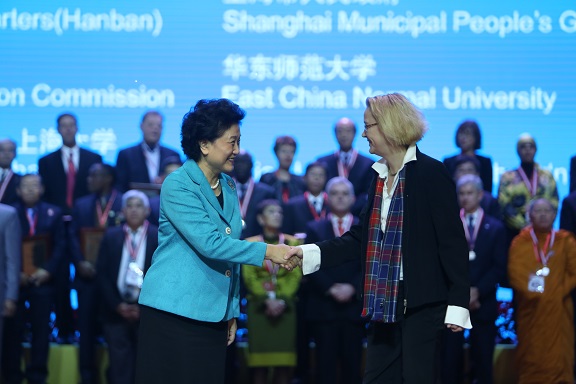
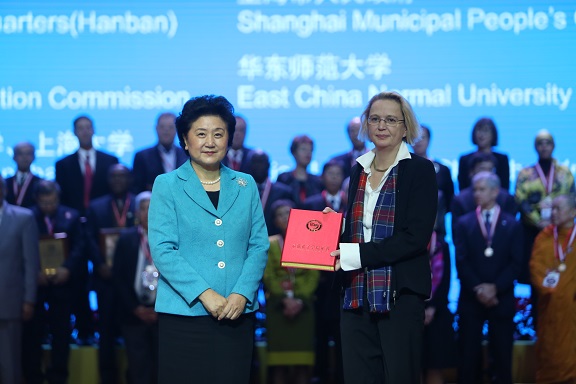
The 10th Global Conference of Confucius Institutes (CI) held in Shanghai in early December 2015 saw the Confucius Institute for Scotland receive the accolade of ‘Model Institute’ from Vice Premier Liu Yandong who is chair of the Council of CI Headquarters.  

Since opening in 2007 the Institute has received six awards of excellence from Hanban for the quality of its work and the impact of its outreach programmes. In 2008, the Institute coordinated the ten-month long ‘China Now in Scotland’ festival and significantly increased its programme of language classes. December 2008 saw a second Award for Excellence being given to the Institute. Additional Awards for Excellence followed in 2009 and 2010 culminating in a Gold Medal Award for Outstanding Contribution which was awarded in December 2011 with an additional award for Excellence being given also in 2012.

In 2014, the 10th anniversary year of the establishment of the network, the Principal of the University of Edinburgh received a  Pioneer Award – one of only 10 such awards marking the 10th anniversary of the establishment of the CI network. This year’s Model Institute award brings the total number of awards to the Confucius Institute for Scotland in the University of Edinburgh, to eight.

Also in receipt of an award for Confucius Classroom of the Year was the Confucius Classroom at the City of Edinburgh hosted by Leith Academy.

The global network stands now at 500 Institutes and just over 1000 classrooms in 134 countries around the world. For more information on the Conference please visit Hanban’s website here.

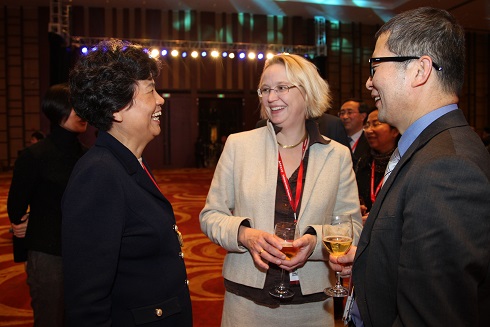
Photographs: Institute Director, Professor Natascha Gentz, is shown receiving and being congratulated on the award by Vice Premier Liu Yandong before chatting with Hanban CEO Mme Xu Lin along with Co-Director Dr Jin Ri. 

award

award

award

Golden Chopsticks Film Gala, 9 Dec 2pm-5pm

Students who take the course “Chinese Silent Cinema, 1922-1935” form groups and make their own 20-minute films modelled on the thematics and aesthetics of silent-era Chinese films.

As a conclusion to this class, all student films are shown at a mock Oscar event known as the “Golden Chopsticks Film Gala.” Judges made up of faculty members and experts determine Golden Chopsticks winners in ten categories: Best Picture, Best Director, Best Cinematography, Best Actress in a Lead Role, Best Actor in a Lead Role, Best Actor in a Supporting Role, Best Actress in a Supporting Role, Best Music, Best Set Design, and Best Poster.

Programme

2:00        Introduction
2:10       “Change of Heart” 覆水難收
2:50       “The Only Dance” 舞夜
3:30       “Blue Gardenia” 蘭梔子
4:00        Bloopers
4:30        Golden Chopsticks Awards
5:00        Farewell

Venue and Timing

The 2015 entrants for the ‘Golden Chopsticks’ award will be screened at 50 George Square Room G.04 Screening Room on Wed 9 Dec 2015 from 2pm-5pm.

Please click HERE to download the poster of the event.
For more information on this event and to view the 2014 films, please visit Chinese Silent Film page.

One Belt, One Road: Briefing Session, Report, & Webinar

On Wed 9 December in Glasgow, China Britain Business Council will run a briefing event focusing on opportunities for businesses related to the One Belt One Road initiative, launched by Chinese President Xi Jinping in 2013.

The programme will present the key findings of a report into this initiative to improve and create new trade routes, links and business opportunities with China, which will pass through over 60 countries along the way, through Asia, Europe, the Middle East and Africa.

Jeff Astle, CBBC’s Executive Director, and Nathan Blunt from the FCO, will lead the session along with panellists from companies which are actively involved. Initial opportunities exist in infrastructure development, financial and professional services, advanced manufacturing and transport, agriculture, energy and resources, logistics, construction and master planning, as well as regionally in ports, tourism and environmental industries.

If you are unable to attend the event but would like to either download the report or take part in a webinair session you can do so by clicking here.


Language Classes 2016 – now open for booking

We offer a diverse programme of evening classes for adults to enjoy learning Chinese. Terms run from Sept-Dec; Jan-Mar; Apr-Jun with a condensed programme of classes offered over the summer.

An absolute beginner can join us at the start of each term. Any student who has some previous experience in learning the language is welcome to drop in for an initial assessment to help determine which class would best suit.

Classes run for two hours on the same evening for a ten week term. After three terms most students are ready to move to the next level. No assessment is carried out but students are encouraged to test their developing skills by sitting the globally run HSK test.

Excellence in teaching is paramount. Most of our teachers are seconded from Fudan University which regularly send us experienced senior teachers and a number of Masters candidates in Teaching Chinese to Speakers of Other Languages. You can see the profiles of our current and previous teachers by clicking here.

LANGUAGE CLASSES January-March 2016

Course bookings for the winter term will open in December 2015. To get more information, register your interest in advance, or request an assessment meeting if you have some previous learning, please email: info@confuciusinstitute.ac.uk

CLass level Code Day(s) Dates-all 2016 Time Full Price / Student
Chinese 1.1  CH040-217 Monday 18 Jan-21 Mar 6.00-8.00pm £130/£86
 CH040-220 Tuesday 19 Jan-22 Mar 6.00-8.00pm £130/£86
CH040-219 Wednesday 20 Jan-23 Mar 6.00-8.00pm £130/£86
 CH040-218 Thursday 21 Jan-24 Mar 6.00-8.00pm £130/£86
Chinese 1.2  CH044-217 Monday 18 Jan-21 Mar 6.00-8.00pm £130/£86
 CH044-218 Wednesday 20 Jan-23 Mar 6.00-8.00pm £130/£86
Chinese 1.3 CH046-208 Thursday 21 Jan-24 Mar 6.00-8.00pm £130/£86
Chinese 2.1  CH041-207 Wednesday 20 Jan-23 Mar 6.00-8.00pm £130/£86
Chinese 2.2  CH037-206 Monday 18 Jan-21 Mar 6.00-8.00pm £130/£86
Chinese 2.3 CH011-205 Monday 18 Jan-21 Mar 6.00-8.00pm £130/£86
Chinese 3.1  CH045-205 Tuesday 19 Jan-22 Mar 6.00-8.00pm £130/£86
Chinese 3.2  CH036-206 Thursday 21 Jan-24 Mar 6.00-8.00pm £130/£86
Chinese 3.3  CH012-204 Thursday 21 Jan-24 Mar 6.00-8.00pm £130/£86
Chinese 4.1  CH038-205 Tuesday 19 Jan-22 Mar 6.00-8.00pm £130/£86
Chinese 4.2  CH013-205
Thursday 21 Jan-24 Mar 6.00-8.00pm £130/£86
Chinese 4.3 CH008-203 Tuesday 19 Jan-22 Mar 6.00-8.00pm £130/£86
Chinese 5.1  CH009-203 Wednesday 20 Jan-23 Mar 6.00-8.00pm £130/£86
Chinese 6.1  CH015-202 Wednesday 20 Jan-23 Mar 6.00-8.00pm £130/£86
Chinese 6.2  CH019-201
Monday 18 Jan-21 Mar 6.00-8.00pm £130/£86
Chinese Advanced  CH002-203 Monday 18 Jan-21 Mar 6.00-8.00pm £130/£86

Calligraphy Classes in the New Year

Our well established calligraphy classes run by Chi Zhang are open to both beginners and improvers.  Under the expert guidance of our calligraphy tutor many students have learnt the joy of discovering and practising this ancient art.

For next term, Winter 2016, we are running a 10 week course on Tuesday evenings 6pm-8pm with the first class starting on 19 January 2016.  Classes take place in the main teaching room of the Institute and all materials are provided.  Please note that this term there will be no class on Tues 2nd Feb 2016.  The final class will therefore take place on Tues 29 March 2016.

To book a place on this rewarding course please complete and return the registration form below along with your cheque payment for £150 (£120) made out to the University of Edinburgh. Cash payment can be made at the Institute office.

Winter2016-CalligRegForm.

Meantime, enjoy this video showing Chi Zhang at work and see some work made by his students.